Decision-Making

Blaming Lead Quality Creates Learned Helplessness
In sales, blaming “bad leads” is a tempting escape hatch when numbers slip. But mounting evidence shows this mindset backfires. Externalizing blame (“the leads suck”) breeds what psychologists call learned helplessness, sapping performance and motivation. Top sales organizations are flipping the script – instead of waiting for golden leads, they’re investing in opportunity creation skills to turn any lead into a deal. Below, we augment the key points of this approach with recent statistics and research findings. The data paints a clear picture: reps who take ownership of their pipeline – through better mindset, process, and technique – consistently outperform those who pin their hopes (and excuses) on lead quality.
1. External Blame Erodes Performance and Motivation
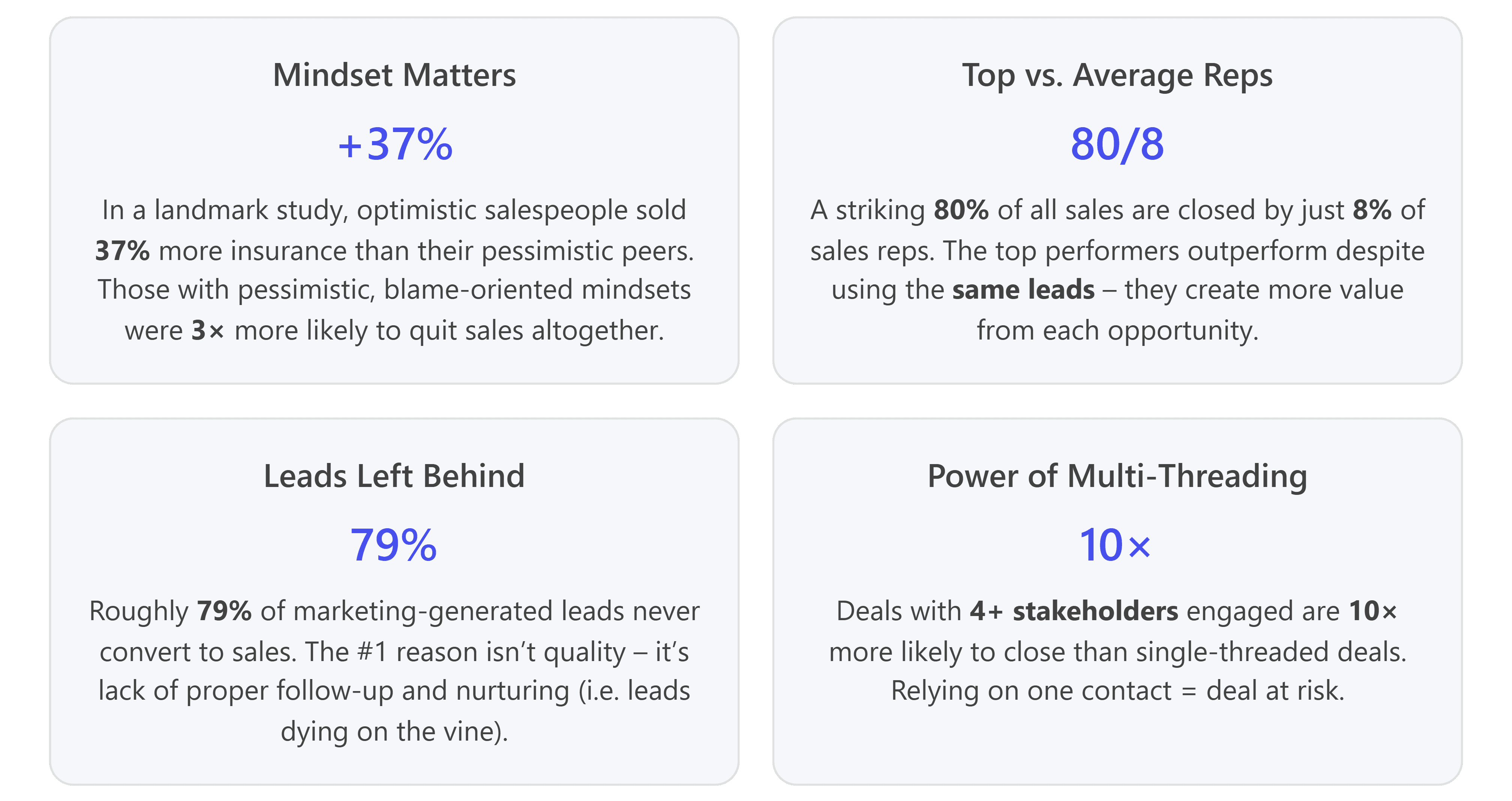
Sales is tough, and repeated rejection can breed a sense of helplessness. But blaming factors outside your control – like lead quality – only makes it worse. Psychological research shows that when people attribute failures to external causes they “can’t control,” their effort and persistence plummet. In sales contexts, Dr. Martin Seligman’s studies on explanatory style are eye-opening: Life insurance agents who had an optimistic mindset (believing they could overcome setbacks) sold 37% more than more pessimistic agents. Meanwhile, those with a pessimistic, helpless outlook were three times more likely to quit their jobs within a year. The reason is simple – if a rep convinces themselves “these leads are garbage, there’s nothing I can do,” then they stop trying. Activity levels drop, creativity in outreach halts, and skill development stagnates. It becomes a self-fulfilling prophecy: giving up ensures poor results, “proving” the rep’s point that success was out of their hands. In contrast, high performers maintain an internal locus of control – they assume their actions (better discovery, better follow-up, sharper messaging) can influence the outcome, even if leads aren’t perfect. This creates a virtuous cycle: they try harder and smarter, which leads to more wins. As one Harvard Business Review analysis put it, companies with reps who take ownership (versus blame) see significantly higher growth because those reps proactively find ways to hit targets instead of making excuses. The takeaway? Blaming lead quality is not just unproductive – it’s psychologically debilitating. Cultivating a mindset of agency (“I have levers to pull here”) keeps motivation high and performance resilient, even when leads vary in quality. [hoffeldgroup.com] [grapenordic.com]
2. Top Reps Outperform Peers with the Same Leads
If “better leads” were truly the key to success, then reps on the same team with the same territories would have similar results. In reality, the gap between top sellers and the rest is massive. One well-known analysis found the top 20% of salespeople often drive over 60% of revenue. In more extreme cases, 8% of reps close 80% of the sales! These top performers are not necessarily getting special treatment or magical inbound leads – they’re simply converting the available leads at a much higher rate. McKinsey research across 500+ B2B sales forces confirms that “leader” reps dramatically outperform “laggard” reps on the same playing field. In fact, the top quartile companies (with strong sales talent and process) generate ~2.5× the revenue per salesperson of bottom-quartile companies. Another study by a sales performance firm showed the best 30% of reps outsell the bottom 30% by up to 4X in the same organization. The point is: it’s not the leads, it’s the skill in handling the leads. Elite sellers approach every lead – even ones others might dismiss – with a strategic plan to maximize it. They qualify deeper (often uncovering a real project where others saw a tire-kicker), they persist longer (we’ll see data on follow-up below), and they engage more decision-makers (turning a small inquiry into a big deal). As sales veteran J. Lemkin famously noted, “a great rep can close 9x more than a poor rep, even with the same leads”. Organizations that recognize this focus on rep enablement and process to raise everyone’s game, rather than praying for better leads. And when average reps are coached to adopt best practices, their results improve dramatically – proving it was never just about lead source or territory. High performers make their leads good. [leadfuze.com] [mckinsey.com] [kellercent...baylor.edu]
3. Opportunity Creation Is a Teachable, Repeatable Skill
The good news is that what top sellers do can be learned. Converting a “weak” lead into a win isn’t luck or alchemy; it’s the result of specific behaviors that can be trained and made into a process. Research by CSO Insights backs this up: companies that implement a formal sales process for developing leads into opportunities see a 37% higher win rate than those that don’t. In other words, having a defined methodology for things like discovery, qualification, and next steps makes the whole team more effective at turning leads into deals. It’s no longer left to chance or individual heroics. For example, a company might train reps on a structured discovery framework (to consistently uncover pain points and stakeholders) and a playbook for lead nurturing. The result? More reps hit quota. A CSO Insights study noted that firms where salespeople “felt well-trained in the sales process” outperformed others by 21.5% – meaning their results were more consistently high, not just driven by a few stars. This reduces performance variance across the team (less dependency on that one superstar who “figures it out”). It also improves onboarding of new reps: when you teach them how to create opportunities step by step, they ramp up faster and more reliably. Gartner refers to this as moving from an “art” to a “science” in sales. And scientific it is: even elements like how many attempts to contact a lead, how to revive a stalled deal, or how to engage a buying group can be codified into best practices and metrics. Organizations embracing this have more predictable pipelines and forecasts because opportunity creation isn’t ad hoc; it’s baked into the system. In sum, treating pipeline generation as a disciplined, coachable process (rather than praying that Marketing throws over a perfectly qualified lead) pays off in higher win rates and a more scalable sales engine. It shifts the culture from “we need better leads” to “we can make leads better” – a far more empowered stance. [grapenordic.com] [grapenordic.com], [grapenordic.com]
4. Reactive vs Proactive Mindset: The Performance Divide
Mindset has a direct impact on sales behavior. Reps who are reactive – waiting for ideal conditions – tend to do the minimum and fall behind. Proactive, strategic reps take initiative to shape outcomes. We’ve already seen how an optimistic/internal mindset correlates with higher sales (37% more) and lower turnover. Let’s add another angle: responsiveness and persistence. A study by InsideSales found that 35–50% of sales go to the vendor that responds first to a buyer inquiry. In a reactive mindset, a rep might delay their response or only give a cursory reply, especially if they think the lead isn’t hot – and they’ll likely lose the deal to a hungrier competitor. A proactive rep pounces on every lead quickly, increasing their chances. Likewise, proactive reps don’t give up after one attempt. Data shows 44% of sales reps give up after a single follow-up attempt, yet studies by MarketingSherpa and others indicate that 80% of sales require at least 5 follow-ups. The rep who assumes the prospect isn’t interested after one unanswered call is being reactive (leaving the ball in the buyer’s court). In contrast, high performers behave strategically: they schedule a series of touches across mediums, they try different angles, and they keep adding value. This persistence means they convert leads others would have abandoned. No surprise, then, that organizations with a proactive, outbound culture generate far more pipeline. One survey of UK sales pros found 47% prioritize having “quiet hours” for outbound prospecting – they proactively carve out time to create opportunities, rather than just react to inbound. These firms saw better pipeline coverage than those waiting on Marketing. The key point: a strategic mindset (how can I move this forward?) beats a passive one every time. Blaming leads is passive; asking “what else can I do” is active. The gulf in results is enormous – in both individual performance and team outcomes. As an example, a tech company that trained its team to always suggest next steps (rather than say “call me if you’re interested”) saw consistent improvement in moving prospects to pipeline, because reps were now leading the process. Being proactive in guiding buyers and tackling challenges head-on leads to more wins, whereas simply reacting (or worse, doing nothing) lets deals slip away. In essence, sales rewards the doers, not the blamers. [hoffeldgroup.com] [blog.hubspot.com] [leadfuze.com] [blog.hubspot.com]


5. Better Discovery & Qualification = Better Conversion
One of the core skills of opportunity creation is deep discovery – learning enough about a prospect’s needs and pains to craft a compelling solution. Reps who rush or skip discovery fail to add value and often chalk up the lead as “no good.” But research shows that when reps dig deeper, conversion rates soar. A Gong.io analysis of hundreds of thousands of B2B sales calls found that top-performing reps ask nearly 2× more targeted questions on discovery calls than average reps. By uncovering “hidden” challenges, additional stakeholders, and broader impacts, they expand the deal’s scope and the buyer’s urgency. In practical terms, instead of accepting a vague “we’re fine for now,” a great rep will ask follow-ups like, “How are you handling X currently? Any pain points there?” – often revealing a problem the buyer wasn’t fully aware of. This can transform a lukewarm lead into a high-value opportunity. High performers also qualify deeper, not faster. Rather than treating discovery as a checklist to decide “yes or no” on pursuing the lead, they use it to find multiple dimensions of value. For example, they won’t stop at one problem; they’ll explore upstream and downstream issues (e.g., how a logistics issue is impacting sales and customer experience). This not only qualifies the lead (proving it’s worth pursuing) but also increases the potential deal size and win probability – because the buyer sees a bigger picture. There’s evidence for this: companies that excel at needs discovery and solution mapping report significantly higher proposal win rates than those that don’t. Additionally, a Salesforce report noted that high-performing sales teams are 2.2× more likely to rigorously research customer pain points before a pitch. Early diagnosis of the “problem behind the problem” is another game-changer. CEB/Gartner research famously found that B2B buyers are often 57% through their decision process before talking to sales – meaning they might frame their needs incorrectly. The best reps use discovery to reframe the buyer’s thinking, often identifying a root cause issue. This can increase win rates by creating urgency (the buyer realizes the true cost of inaction). In short, thorough discovery is a lead-quality multiplier: it turns meh leads into solid opportunities by revealing value that others missed. And it’s a skill any rep can learn with the right training and mindset. (It’s no coincidence that methodologies like SPIN Selling, MEDDIC, etc., all emphasize asking good questions – it works.) [triplesession.com] [grapenordic.com]
6. Internal Champions: The Key to Momentum and Win Rates
Many deals are won or lost based on whether the rep can cultivate an internal champion – someone on the buyer’s side who advocates for your solution. Blaming a “bad lead” often means the rep failed to find a champion and navigate the account. Data underscores the importance of multi-threading (engaging multiple contacts). According to Gong’s analysis, deals with 4 or more stakeholders involved have close rates around 40%, versus only 4% when you only have a single point of contact. That’s a 10× higher success rate by multi-threading the opportunity. Why? Because having an internal champion (and ideally a few supportive influencers) mitigates the common deal killers: inertia, doubt, and internal opposition. Top sellers make a point to identify a potential champion early – the person with the most to gain from solving the problem – and then enable that champion. They provide them with ammunition: case studies to share internally, ROI calculations, slide decks tailored to various execs’ concerns, etc. The effect is powerful. One sales study noted that in 90% of won deals, the salesperson had an identified champion, whereas lost deals were often single-threaded with no strong advocate. By equipping a champion to sell on your behalf when you’re not in the room, you drastically improve win odds. Research by Gartner confirms that the typical B2B buying group now involves 6–10 people. Without a champion to rally those people, deals stall (“no decision”) or choose a safer option. A proactive rep will even coach the champion – e.g., “Here’s how to present this to your CFO,” or “If you get pushback on X, here’s a point you can make.” This turns the lead from a one-to-one sale into a one-to-many sale within the account, exponentially increasing its chance to close. Conversely, reps who complain about lead quality often haven’t dug into the org chart or tried to spark any internal enthusiasm; they’re just passively responding to one contact. The stats clearly favor the multi-threaded approach: when sellers engage at least 3 stakeholders, win rates jump to 15% (vs 4% with one), and engaging 4+ people can hit ~40% win rate. That’s how high performers consistently “beat” lead quality – by generating consensus and excitement in the buying group, effectively creating a strong opportunity where one individual’s interest might have fizzled. [mysalescoach.com]
7. Next Steps & Momentum: Engineering the Win
One hallmark of opportunity-creators is that they drive clear next steps and maintain deal momentum. Reps who blame leads often let otherwise viable prospects languish because they didn’t lead the process. Research on pipeline velocity shows that deals with a sequence of scheduled next actions close much faster than those that drift. High-performing sellers always leave a meeting with a concrete follow-up booked – they manage the timeline. This keeps the buyer engaged and the opportunity moving forward. The impact on pipeline health is measurable: firms that emphasize disciplined next-step setting have shorter sales cycles and higher conversion of early-stage pipeline to close. Additionally, having structured next steps greatly improves forecast accuracy. A study by Vantage Point found that companies with formal pipeline management (i.e. tracking next steps, stages, and probabilities) had forecast win rates 20+ percentage points higher than companies without that rigor. In practice, this means if a deal didn’t have a scheduled next interaction, it was far less likely to close when predicted. By contrast, reps who manage via “hoping the buyer gets back to me” often see their forecasts slip or deals vanish – then they blame the lead. By treating each lead like a project with a timeline, you greatly increase its chance of success. To illustrate: one SaaS company noticed that reps who set a next meeting during the first call converted leads to pipeline at a much higher rate. They made it a sales process rule that every qualified lead should have a next event on the calendar. Within a quarter, their pipeline advancement rate improved by double digits and leadership had much clearer visibility into which deals were real. All because the reps were now actively engineering progress rather than passively waiting. Moreover, having defined next steps helps surface weak opportunities early (if the prospect won’t agree to anything, perhaps they’re not serious). That allows reps to focus effort where there is mutual commitment, further improving resource allocation and win rates. In summary, momentum isn’t luck – it’s created. Reps who orchestrate the sale (set agendas, recap value, schedule follow-ups, loop in stakeholders) convert far more leads into wins than those who leave things open-ended. The former group’s pipelines thrive; the latter’s pipelines unpredictably sputter. [mysalescoach.com], [mysalescoach.com] [grapenordic.com]
8. Outbound Mindset Pays Off in Pipeline Health
Shifting from a lead-dependent mindset to an opportunity-creation mindset has big benefits for long-term pipeline health, including outbound sales success. Rather than waiting for marketing to hand over perfect leads, high-growth teams prospect proactively and nurture contacts over time – essentially creating their own leads. The payoff can be quantified. Forrester Research finds that companies excelling at lead nurturing generate 50% more sales-ready leads at 33% lower cost compared to those that don’t nurture. In other words, when sales (often in partnership with marketing) consistently follow up, educate, and build relationships, the funnel fills up with qualified opportunities at a higher rate and lower expense than just throwing more raw leads at the team. Additionally, nurtured leads produce 20% more sales opportunities than non-nurtured leads – meaning an outbound cadence that provides value (e.g. sharing insights, staying in touch) will eventually yield more pipeline from the same pool of prospects. Importantly, these opportunities tend to be larger: one study showed that on average, nurtured leads result in 47% higher purchase values than leads that were contacted once and dropped. This makes sense – by the time a nurtured prospect enters an active buying cycle, they trust your company more and have a clearer vision of the solution, often leading to a broader implementation. Now think about a rep who only focuses on the low-hanging fruit and complains about the rest. They miss out on that long-term equity. By contrast, a rep who adopts an outbound mindset – treating even cold or early-stage contacts as “future opportunities” to be cultivated – builds a personal pipeline that matures over quarters. When their target accounts are ready to solve a problem, that rep is the one they call, because the rep stayed on their radar with helpful touches. The result is a fatter, healthier pipeline that isn’t 100% reliant on this month’s inbound MQLs. This proactive outbound approach also inoculates teams against market downturns or lead flow fluctuations. If inbound slows, they’ve been seeding their own opportunities through outbound all along. It’s inherently more controllable. We saw earlier how one metric found 79% of leads never convert mainly due to neglect. Outbound-minded teams don’t let leads die – they keep working them until there’s a clear “no.” And often, a “no for now” turns into a “yes” 6 or 12 months later when circumstances change. In short, an opportunity creation mindset isn’t just for reactive leads – it supercharges outbound sales too, by focusing reps on the actions that create pipeline (researching, messaging, connecting, educating). Over time, this compounding effort yields a robust pipeline and a steady stream of self-generated deals, which is the ultimate antidote to lead-quality woes. [blog.hubspot.com]
9. Organizational Outcomes: Predictability, Alignment, and Growth
When a sales org shifts from blaming leads to building opportunities, the effects ripple outward. First, performance variance decreases. Instead of a few heroes carrying the team, a solid process and mindset lifts the middle of the pack. One indicator: CSO Insights found companies with mature lead management/nurturing processes have 9% more sales reps hitting quota on average. That might sound modest, but in a 50-person team it means about 5 more reps making quota – often the difference between hitting the company number or missing it. This happens because standardized opportunity-creation practices make success less random. Second, pipeline predictability and forecast accuracy improve. With every lead worked thoroughly and stages defined clearly, forecasts reflect reality more closely. Organizations with well-managed pipelines are far more likely to forecast deals accurately. In fact, a HubSpot study noted that companies with optimized pipeline practices enjoyed a 28% higher revenue growth rate than those with poor pipeline visibility – partly because they could see and address pipeline gaps early. Some reports even suggest best-in-class firms achieve near 90% forecast accuracy, meaning almost all deals close when expected (the pipeline is that clean). Third, marketing and sales alignment improves once the finger-pointing stops. Instead of “these leads are crap,” the conversation shifts to “here’s how we’re progressing the leads” and what else is needed. Marketing benefits by seeing how leads are developed, and sales benefits from marketing’s help in nurturing content and targeting. Aligned teams absolutely outperform: a study by Marketo/Reachforce found strongly aligned organizations achieved 24% faster three-year revenue growth and 27% faster profit growth than misaligned ones. They also saw win rates rise by over one-third (since good leads weren’t wasted) and even customer retention jump by 36% (as promises made to convert the sale were kept through onboarding). The reduction in friction between marketing and sales – when sales proves it can capitalize on leads, and marketing works with sales to refine lead targeting – creates a cycle of improving lead quality and conversion. Finally, an opportunity-focused culture is more fulfilling and sustainable for the team. Reps feel more in control of their destiny, which boosts morale and lowers turnover. Instead of the toxic blame game (sales vs marketing, or newbies saying “I got bad leads”), you get a culture of accountability and skill growth. Leaders can coach specific behaviors (discovery, multi-threading, follow-up technique) rather than dealing with vague complaints. Over time, the entire sales org becomes more self-sufficient in generating revenue, which is a huge competitive advantage. As one SVP of Sales put it, “We stopped worrying about the leads we didn’t have, and started closing more of the leads we did have”. The numbers we’ve cited bear that out: better conversion beats sheer volume. When each rep is converting more of their pipeline, you need less total leads to hit targets, and every marketing dollar goes further. It’s a win-win-win for sales, marketing, and the company’s bottom line. [blog.hubspot.com] [anthonycol...aining.com] [winsavvy.com] [winsavvy.com], [winsavvy.com]
Blaming lead quality is a dead-end street.
The evidence – from psychology experiments to sales org analytics – shows that taking ownership of the conversion process is the hallmark of high performance. By treating every lead as an opportunity (until proven otherwise) and arming yourself with the skills and systems to develop it, you reclaim control. That shift from victim to owner yields concrete results: higher sales, larger pipelines, more consistent forecasts, and tighter team alignment. The data we’ve presented gives confidence that this isn’t just theory; it’s replicable fact. Just as importantly, it’s empowering. Sellers and leaders alike can break free from the “bad leads” trap and instead focus on what can be done – because there is always something that can be done. Whether it’s asking better questions, finding an internal champion, or simply making that fifth follow-up call, these actions move the needle. Over time, they compound into a superior win rate and a healthier sales organization. The best sales teams have learned one of the most valuable lessons in business: inputs may be beyond your control, but how you convert those inputs is almost entirely up to you. And mastering that conversion process is what separates predictable growth from random results. The next time someone says “these leads are junk,” you’ll know – and now have the stats to prove – that the real differentiator isn’t the leads, it’s what your team does with them.