Problems
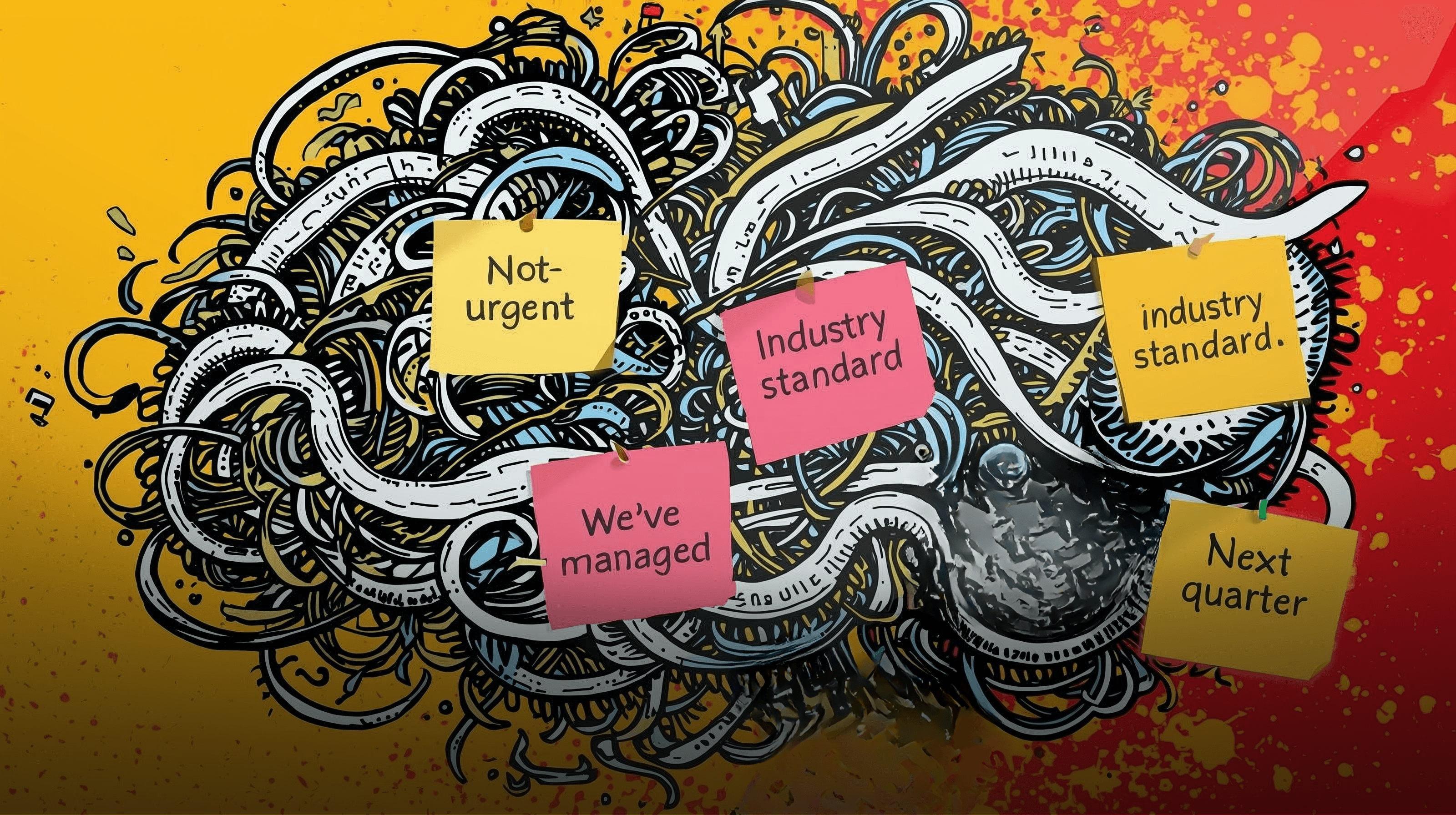
How internal narratives preserve safety, defer accountability, and quietly block action in complex buying decisions
The fast take
In today’s B2B buying, problems are rarely denied. They’re narrated. Buyers operate across ~10 channels with many stakeholders weighing in, so it’s easy to construct reasonable‑sounding stories that explain why now isn’t the time—and those stories spread quickly across the journey. Meanwhile, vendors get only 17% of the buyer’s total purchase time, so these narratives harden mostly off‑call. [courses.wa...ington.edu], [advertisingweek.com]
The macro symptoms are everywhere: 86% of purchases stall somewhere and 81% of buyers end up dissatisfied even after choosing a provider, a clear sign that organizations can recognize issues yet still avoid committing to action. Add to that the reality that 40–60% of qualified opportunities die in no decision because people fear getting it wrong, and the “story beats solution” dynamic becomes hard to miss. [worldcc.com], [pwc.com]
Why smart people lean on stories
Narratives reduce discomfort and protect identity. When fixing a problem implies past mistakes, threatens credibility, or elevates personal exposure, teams gravitate to explanations that keep reputation intact. Research on modern buying shows looping, non‑linear progress—problem identification, validation, consensus creation—where reframed rationales can maintain harmony without moving the decision forward. [books.google.com]
Stories aren’t lies. They highlight true constraints (timing, scope, dependencies) but overweight them enough to justify inaction—especially when late‑stage risk owners like security, privacy, legal, and finance will scrutinize the choice. Note that 98% of organizations say external privacy certifications influence purchasing; that scrutiny makes risk‑avoiding narratives even more attractive. [worldcc.com]
The four most common avoidance stories
Timing: “It’s real, but not this quarter.” With buyers juggling many channels and initiatives, it sounds rational; it’s also how decisions drift into the 86% stall statistic. [courses.wa...ington.edu], [worldcc.com]
Scope: “It’s too big to tackle meaningfully.” True sometimes, but also a way to keep ownership fuzzy so nothing starts. [books.google.com]
Dependency: “We must wait for Team X/system Y.” Often accurate, but conveniently shifts responsibility outside the room—fuel for no‑decision. [pwc.com]
Normalization: “Everyone in our industry has this.” If it’s universal, urgency fades and the problem becomes a talking point, not a plan. [worldcc.com]
Each narrative provides coherence without commitment.


How stories distort priority and planning
Once a story sticks, meetings migrate from deciding to monitoring. Plans stay high‑level. Owners aren’t named. Momentum looks like motion but recycles through the same “next steps,” which aligns perfectly with the non‑linear, looping nature of buying jobs. The cost shows up later in late‑gate friction and post‑signature regret (a contributor to that 81% dissatisfaction figure). [books.google.com], [worldcc.com]
How sellers unintentionally reinforce the story
Empathy can become collusion. Agreeing that “the timing is tough,” accepting that “scope is too broad,” or waiting passively on dependencies validates the narrative—and makes it harder for the buyer to exit without losing face. That’s one path to 40–60% no‑decision outcomes: fear stays unaddressed while rationales stay polite. [pwc.com]
What elite sellers listen for (and what they do next)
Listen for function, not just content. Ask yourself: What risk does this story reduce? Whose exposure does it avoid? Which decision does it postpone? Repetition across meetings is a tell: facts don’t change, but the story keeps returning. That’s emotional work, not analytical work. [books.google.com]
Offer a safer counter‑narrative tied to action. Instead of challenging the story head‑on, introduce a narrative that preserves identity and enables movement:
From “not now” → “a 60‑day feasibility to be ready when the window opens.”
From “too big” → “a bounded pilot in one function, with Day‑30/60 metrics and rollback.”
From “we rely on Team X” → “parallel prep work we can own while X finishes.”
These moves lower fear (the no‑decision driver) and create a professional, defensible story of diligence rather than a risky leap. [pwc.com]
Bring late‑gate proof forward. A lightweight governance pack (privacy/security posture with recognized certifications; finance‑ready TCO sensitivity) disarms the future objections that make avoidance stories persuasive. It also reduces the ~8.6% average contract value erosion tied to misaligned expectations at signature. [worldcc.com], [financedigest.com]
Use rep‑assisted checkpoints. Buyers are 1.8× more likely to report a high‑quality purchase when supplier digital tools are paired with a rep at critical moments. Plan those moments at each internal gate to keep the new action narrative intact. [hbr.org]
Mini‑playbook: turn stories into steps
Name the protected asset (quietly). “If this slips again, whose KPI moves or who answers the CFO/CISO?” Silence reveals fear; answers reveal owners. [worldcc.com]
Offer a bounded path. Document Day‑30/60 success criteria and explicit rollback so acting ≠ irreversible risk. That’s the antidote to no‑decision. [pwc.com]
De‑risk the late review. Attach privacy certifications and TCO sensitivities now to keep the narrative from reverting to delay later. [worldcc.com], [financedigest.com]
Orchestrate rep‑assisted reviews. Insert yourself where quality jumps 1.8×. [hbr.org]
The punchline
Most buyers aren’t avoiding problems because they don’t care. They’re protecting identity and minimizing exposure across a sprawling, multi‑channel, multi‑stakeholder reality. Stories are how they stay comfortable in discomfort.
Facts alone won’t beat a good story. A safer story paired with a smaller step will. Design a path that lets your champion move without fear—and you’ll convert narratives into outcomes while everyone else keeps debating “timing” on yet another call. [courses.wa...ington.edu], [advertisingweek.com], [worldcc.com], [pwc.com]