Problems
Why organizations tolerate known problems, how perceived risk distorts decision logic, and what enables movement when inertia feels rational
Stability now outranks improvement
Buying groups are larger, more cross‑functional, and more omnichannel than ever. B2B customers use about ten interaction channels and will switch suppliers if the experience is clunky, which expands the number of voices who can veto change and elevates the political cost of failure (McKinsey B2B Pulse 2024). At the same time, buyers spend only 17% of their total purchase time with all vendors combined, so most risk‑reduction work happens internally, where status‑quo preferences can harden without the seller present (Gartner press release). [courses.wa...ington.edu] [advertisingweek.com]
The system‑level result is visible: 86% of B2B purchases stall somewhere in the process and 81% of buyers report dissatisfaction even with the provider they eventually select, signaling that organizations increasingly favor survivable stability over uncertain improvement (Forrester: The State of Business Buying, 2024). [worldcc.com]
Why familiar pain is discounted and unfamiliar risk is amplified
Sales teams routinely meet buyers who quantify inefficiency yet hesitate to act. The behavior is rational under uncertainty. Large‑scale analysis of 2.5 million recorded sales conversations shows 40–60% of qualified opportunities end in no decision, driven more by fear of making the wrong choice than by lack of value (Harvard Business Review). In Gartner’s non‑linear buying model, teams loop across problem identification, validation, and consensus—stages where unfamiliar change invites scrutiny, while familiar pain feels predictable and survivable (Gartner B2B buying journey). [pwc.com] [books.google.com]
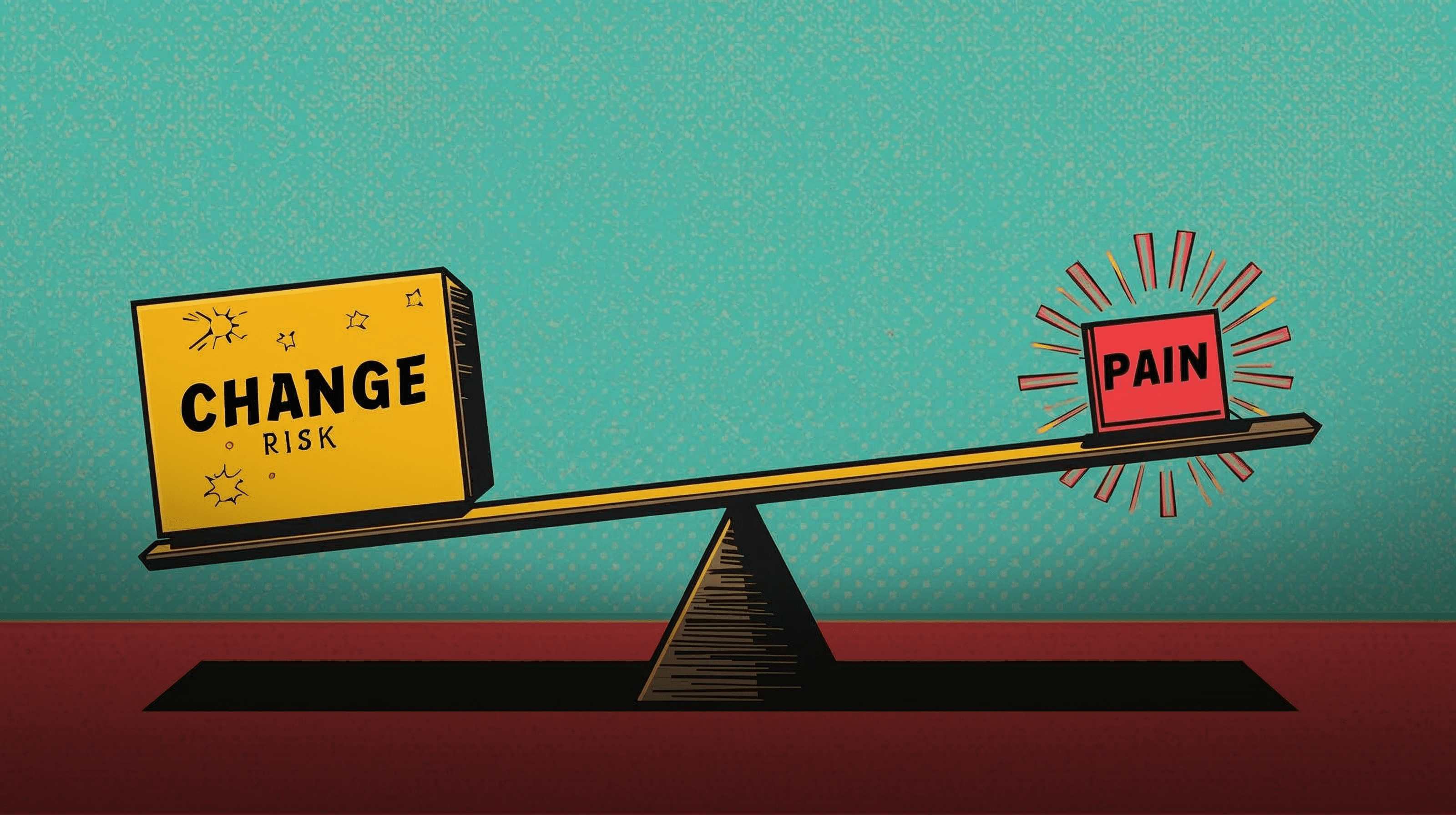
Bottom line: when the perceived cost of change exceeds the tolerated cost of pain, inertia feels like good governance.
Expert lens: pain without consequence rarely moves the system
Executives know teams will normalize pain they can survive. Workarounds become routine. KPIs shift. What was once “broken” becomes “manageable.” But change concentrates risk on a sponsor who must pass late gates (security, privacy, legal, finance) and answer for outcomes. Those late‑cycle risk owners wield real power; for example, 98% of organizations say external privacy certifications influence purchase decisions, so failure to satisfy these proofs feels more dangerous than living with the current pain (Cisco 2024 Data Privacy Benchmark). [worldcc.com]
When change proceeds without clarifying risk and ownership up front, the cost is tangible later: organizations lose ~8.6% of contract value on average to misaligned expectations and rework, a penalty of pushing “improvement” without de‑risking it (Deloitte–WorldCC). [financedigest.com]
How the internal comparison gets skewed
Organizations compare pain and change asymmetrically:
Pain is assessed retrospectively: “We survived last quarter; we can survive next quarter.”
Change is assessed prospectively: “What if we miss, get audited, or overspend?”
Gartner’s looped buying jobs make this asymmetry durable; each loop invites fresh negative scenarios and past failure anecdotes, which inflate change costs while yesterday’s pain looks contained (Gartner B2B buying journey). The risk calculus tilts toward no decision, consistent with HBR’s finding that fear—more than value gaps—kills deals (HBR). [books.google.com] [pwc.com]


Why organizations shrink the pain and inflate the change
To preserve equilibrium, teams:
Minimize pain by labeling it a trade‑off or industry norm, which dovetails with Forrester’s finding that many buyers are ultimately dissatisfied—an indicator that expectations were managed around tolerance rather than outcomes (Forrester 2024). [worldcc.com]
Magnify change by emphasizing dependencies and worst‑case scenarios during validation and consensus loops, which stretch timelines and revive old failures (Gartner buyer journey). [books.google.com]
The result is paralysis but with a posture of prudence.
The common seller mistake
Pushing harder on urgency often backfires. Pressure heightens perceived risk and forces buyers to defend caution—strengthening the “change is costlier than pain” story, which tends to end in no decision (HBR). [pwc.com]
High performers take a different tack: they lower the felt cost of change rather than inflating the pain.
Reframing change: from leap to step
The practical antidote is containment:
Phase the work into feasibility → expansion → consolidation, aligning to how buying groups actually progress across jobs (Gartner). [books.google.com]
Add reversibility via explicit rollback criteria and Day‑30/60/90 gates to counter the fear dynamics documented in the no‑decision research (HBR). [pwc.com]
Bring late‑gate proof forward with a lightweight governance pack (privacy/security certifications; finance‑ready TCO sensitivity) so future vetoes are neutralized early, reducing the ~8.6% erosion risk (Cisco 2024; Deloitte–WorldCC). [worldcc.com], [financedigest.com]
Schedule rep‑assisted checkpoints at key internal gates; buyers are 1.8× more likely to report a high‑quality purchase when supplier digital tools are paired with a rep, which helps navigate fear‑spikes at the exact moments that matter (Gartner B2B Buying Report). [hbr.org]
Containment shifts the comparison from “endure pain vs risk everything” to “endure pain vs test improvement safely.”
Case in point
A finance team lived with a reporting process that required manual tie‑outs and frequent corrections. Pain was well understood; change had been discussed and deferred multiple times. Emphasizing ROI didn’t move the deal.
The seller reframed change as a 60‑day pilot on one reporting stream with clear Day‑30/60 metrics, rollback, and a mini governance pack to pre‑clear security/finance. The team approved quickly—the pain didn’t worsen, the perceived cost of change fell beneath it. The approach mirrors research showing that fear—not lack of value—blocks action and that early governance reduces late‑stage erosion (HBR; Deloitte–WorldCC). [pwc.com], [financedigest.com]
Implications for sales leadership
Diagnose the equation. Are we losing to under‑estimated pain or over‑estimated change cost? Stall and dissatisfaction stats suggest the latter in many pipelines (Forrester 2024). [worldcc.com]
Coach for de‑risking, not dramatizing. Replace “turn up urgency” with “turn down exposure”: phases, rollback, governance proofs, rep‑assisted gates (Gartner B2B Buying Report). [hbr.org]
Forecast on readiness artifacts. Confidence should rise when pilots, gates, and late‑gate proofs exist—not when an executive says it’s important (a pattern correlated with no decision) (HBR). [pwc.com]
Actionable takeaways
For sellers
Don’t assume pain compels action; fear often prevails. Counter it with reversibility and feasibility gates. [pwc.com]
Front‑load a governance pack (privacy certificates; TCO sensitivity) to calm late‑gate vetoes and protect value. [worldcc.com], [financedigest.com]
Orchestrate rep‑assisted checkpoints at internal decision gates for the 1.8× quality lift. [hbr.org]
For sales leaders
Inspect deals for inflated change narratives (dependencies, worst‑cases, “too big” scope) and coach toward bounded pilots with rollback. [books.google.com], [pwc.com]
Reward de‑risking behaviors that lower perceived change cost instead of pressure tactics that raise it—especially when your team sees buyers only 17% of the time. [advertisingweek.com]
Final insight
Organizations don’t choose pain because they like it. They choose it because it’s known and survivable. When the cost of change looks bigger than the cost of pain, you won’t win by turning up the heat on pain—you’ll win by turning down the risk of change. In modern B2B sales, progress starts not when pain peaks, but when risk falls. [pwc.com]