People
Why individual risk, not organizational logic, ultimately governs buying decisions
Decisions have become personally consequential
Complex B2B buying now happens across many channels and many people, and most of it happens away from sellers. Gartner shows buyers spend only 17% of their total buying time with all potential suppliers combined, so your slice of influence is tiny. Gartner press release. Buying groups have expanded too. Forrester reports an average of 13 internal participants per decision, with nearly 90% of purchases crossing two or more departments. Forrester newsroom. [gartner.com] [forrester.com]
Customers also expect an omnichannel experience and will switch if they do not get it. McKinsey’s 2024 B2B Pulse finds buyers use about 10 interaction channels and follow a “rule of thirds” preference split between in‑person, remote, and digital self‑serve. McKinsey B2B Pulse 2024. [mckinsey.com]
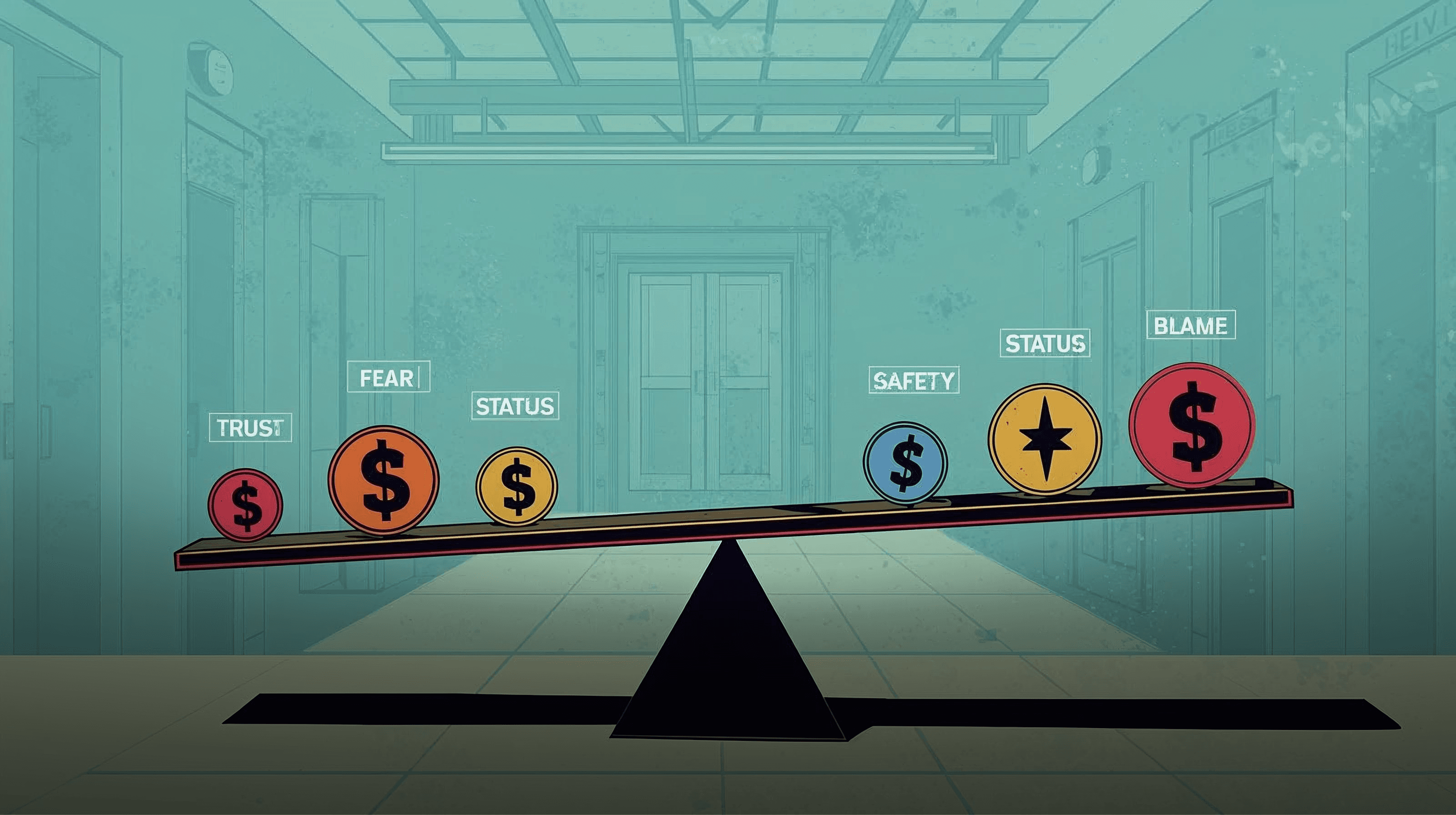
On paper, better governance and more eyes should make approval easier. In practice, rising visibility and lower tolerance for failure raise the personal stakes for approvers. That is why saying yes is often a personal risk calculation long before it is an organizational one.
Personal risk explains most late‑stage hesitation
Many stalled deals are not about competitor wins. They die inside the customer. In an HBR study of 2.5 million sales conversations, 40–60% of opportunities ended in “no decision,” driven by buyer indecision and fear of making the wrong choice. Harvard Business Review. Forrester confirms the friction: 86% of B2B purchases stall and 81% of buyers are dissatisfied even with the provider they ultimately choose. Forrester newsroom. [hbr.org] [forrester.com]
Behavioral science helps explain the stall. Prospect Theory shows people are loss averse. Losses hurt more than equal gains help, so when personal accountability is visible, decision makers become conservative. Kahneman & Tversky 1979 PDF. In organizations, this is amplified by defensive decision‑making: choosing the safer, second‑best option to avoid blame if things go wrong. Research finds defensive choices are common across sectors and rise when psychological safety is low. Journal of Occupational and Organizational Psychology, 2021. [web.mit.edu] [bpspsychub....wiley.com]
Organizations absorb outcomes, individuals absorb consequences
If a purchase underperforms, the company adjusts. Individuals pay the career cost. That asymmetry is why mid‑process confidence collapses even when the business case remains strong. Defensive decisions are widespread. In a study of 950 public‑sector managers, 80% made at least one defensive decision in the prior year, often to “cover” themselves if results disappointed. SpringerOpen study. [link.springer.com]
The social dynamics of committees add another layer. As groups grow, responsibility diffuses and personal accountability blurs, which encourages caution and delay. See the literature on diffusion of responsibility for the mechanisms at play. ScienceBeta explainer. [sciencebeta.com]
Where personal cost actually shows up
You rarely hear “I’m worried about my career” in plain language. You will see it in behavior:
Defensibility obsession. Requests for documentation, third‑party benchmarks, and certifications are often about protecting the approver, not doubting your value. Privacy is a good case: in Cisco’s global study, 98% of organizations said external privacy certifications are important factors in buying decisions. Cisco 2024 Data Privacy Benchmark PDF; PR Newswire summary. [cisco.com] [prnewswire.com]
Diffusion of ownership. Committees expand and ad‑hoc stakeholders appear late. SBI research shows buying groups now average 11–12 members, with 38–41% of decisions involving the CEO and 58–78% of decisions overruled by senior executives. SBI Growth blog; SBI report release. [sbigrowth.com] [prnewswire.com]
Sequencing delays. Slips to “next quarter” or “pilot first” reduce visibility and spread risk across time. Late additions from legal, security, or finance are common and rational under scrutiny.
Each behavior is a logical response to personal exposure rather than a lack of belief in your ROI.


Who feels the personal cost most acutely
The middle of the organization carries the heaviest burden. Mid‑level leaders are visible enough to be accountable but lack the political capital to absorb failure. Executive scrutiny has risen too. In 2024 buyer surveys, CEOs step in more often, and late vetoes are common. SBI Growth blog; SBI research PDF. [sbigrowth.com] [23541.fs1....nt-na1.net]
Why sellers underestimate personal cost
Most selling motions emphasize business value, ROI, and strategic alignment. Necessary, yes. Sufficient, no. Two dynamics say otherwise:
Indecision trumps competition. As noted, up to 60% of losses are “no decision.” Harvard Business Review. [hbr.org]
Digital self‑service raises regret. Buyers prefer rep‑free journeys, yet regret and second‑guessing rise when they buy without seller assistance. Gartner’s data shows higher purchase regret for self‑service decisions and stronger outcomes when buyers use supplier digital tools in partnership with a rep. Gartner report PDF; Gartner webinar deck. [emt.gartnerweb.com] [s3.amazonaws.com]
Without addressing personal risk explicitly, more logic and more content can create more doubt, not more confidence.
How elite sellers reduce the personal cost of yes
High performers do not eliminate risk. They redistribute it.
Provide defensibility, not just value. Package an approver‑ready “defense file” that includes peer benchmarks, independent certifications, executive references, and a one‑page decision memo the buyer can send up the chain. This aligns with what buyers say builds confidence. Cisco 2024 Privacy study; Forrester blog. [cisco.com] [forrester.com]
Design phased commitments that limit blast radius. Pilot first, define objective exit criteria, and pre‑write rollback plans. Buyers who combine digital tools with seller guidance report higher quality outcomes. Gartner report PDF. [emt.gartnerweb.com]
Share accountability. Offer joint governance, risk registers, and steering cadence. Contract discipline matters here. Poor contracting erodes an average 8.6% of value across organizations, so making obligations and safeguards explicit protects both sides. Deloitte–WorldCC overview; WorldCC ROI page. [deloitte.com] [info.worldcc.com]
Normalize caution. Acknowledge what could go wrong and show how it will be contained. This builds credibility with risk owners and executives who are measured on downside protection. SBI Growth blog. [sbigrowth.com]
Reframing the role of process
Process is not only bureaucracy. It is a personal safety mechanism that converts individual judgment into institutional decision. When you align your proposal to governance standards and auditability, you lower an approver’s exposure and speed returns.
Two practical levers:
Meet the omnichannel expectation. Buyers will mix digital, remote, and in‑person. Offer a seamless path and be prepared for late executive review without reset. McKinsey B2B Pulse 2024. [mckinsey.com]
Anticipate late checks. Expect privacy, security, finance, and compliance to step in. Bring the artifacts they need before they ask. Certifications and clear data‑use statements reduce personal risk for signers. Cisco 2024 Privacy study. [cisco.com]
A brief illustrative case
A department leader offered a verbal yes, then delayed for weeks. Value was clear, but exposure was not. The seller shifted the dialogue from upside to defensibility: peer benchmarks, a privacy and security packet, explicit success metrics, and a limited pilot with exit criteria. The deal closed quickly. The decision did not become more attractive. It became safer. This pattern matches what large‑scale buying research shows about confidence and regret in B2B decisions. Gartner webinar deck; Forrester newsroom. [s3.amazonaws.com] [forrester.com]
Implications for sales leadership
Late‑stage stalls should trigger a new diagnostic: not “is the value clear?” but “is the buyer protected?” Forecasts improve when teams flag personal risk signals, and coaching improves when sellers are trained to reduce exposure rather than push urgency. Most “misses” are not competitive losses. They are preventable “no decisions.” Harvard Business Review; Forrester blog. [hbr.org] [forrester.com]
Actionable takeaways
For sellers
Assume every yes carries personal risk. Diagnose who bears it and why. SBI Growth blog. [sbigrowth.com]
Provide a “defense file” with independent proof points and certifications, not just ROI. Cisco 2024 Privacy study. [cisco.com]
Propose phased commitments with clear exit ramps and shared governance. Gartner report PDF; Deloitte–WorldCC. [emt.gartnerweb.com] [deloitte.com]
Meet buyers where they are across channels and maintain consistency. McKinsey B2B Pulse 2024. [mckinsey.com]
For sales leaders
Add a “personal risk” section to every deal review: who could be blamed if it goes wrong and what protection exists today. SBI report. [23541.fs1....nt-na1.net]
Enable reps with executive‑ready assets that reduce regret and increase decision confidence. Gartner webinar deck; Forrester newsroom. [s3.amazonaws.com] [forrester.com]
Final insight
Large organizations rarely reject good ideas outright. They hesitate when individuals cannot afford to be wrong. The real barrier to commitment is not logic, budget, or fit. It is personal consequence. Sellers who understand the personal cost of saying yes stop asking buyers to be bold. They help them be safe. In today’s B2B environment, safety is what allows progress to resume.