Empathy

Modern Selling Has Moved From Information Advantage to Understanding Advantage
For decades, sales teams relied on information as their primary advantage — product knowledge, comparative insights, and access to data buyers couldn’t easily gather. Today, that advantage has evaporated. Buyers arrive more informed, more prepared, and more skeptical.
What differentiates top sellers now is not how much they know, but how precisely they understand:
their buyers’ motivations, constraints, anxieties, incentives, and internal dynamics.
This shift has reclassified empathy from a “soft” interpersonal quality to a core commercial competency.
It is no longer optional. It is a revenue-producing skill.
Without Empathy, Sellers Misdiagnose Problems and Misalign Solutions
Across pipeline reviews, one pattern explains the largest share of stalled deals: sellers misunderstand or underappreciate the buyer’s real problem.
Common symptoms include:
Technical problems treated as strategic ones
Strategic problems treated as operational ones
Surface-level pain mistaken for root issues
Personal incentives misunderstood
Organizational politics overlooked
Stakeholder fears unaddressed
These misdiagnoses stem from insufficient empathy — not emotional empathy, but cognitive empathy, the ability to accurately perceive how buyers think, decide, and navigate their internal environments.
When sellers lack this skill, they pitch the wrong narrative, prescribe the wrong path, and lose momentum.
Empathy Enhances Decision Quality and Increases Persuasion
Behavioral science demonstrates that empathy increases:
Problem accuracy
Trust formation
Perceived competence
Influence with senior stakeholders
Buyer openness during discovery
Alignment across internal committees
Empathy isn’t about being “nice.”
It is about perceiving the buyer’s world precisely enough to drive effective action.
In commercial environments, empathy is not emotional alignment — it is informational advantage.
Empathy Is Not a Feeling, It Is a Capability
Most sellers misunderstand empathy because they treat it as a personality trait. This leads to two false beliefs:
“Some people are born empathetic.”
“Empathy means agreeing with the buyer.”
Neither is true.
Empathy in a revenue context is the skill of perspective-taking: the ability to understand what the buyer is thinking, feeling, fearing, and calculating — without absorbing the emotion yourself.
It is a structured competence that can be learned, operationalized, and measured.
The Commercial Model of Empathy: Four Dimensions That Drive Revenue
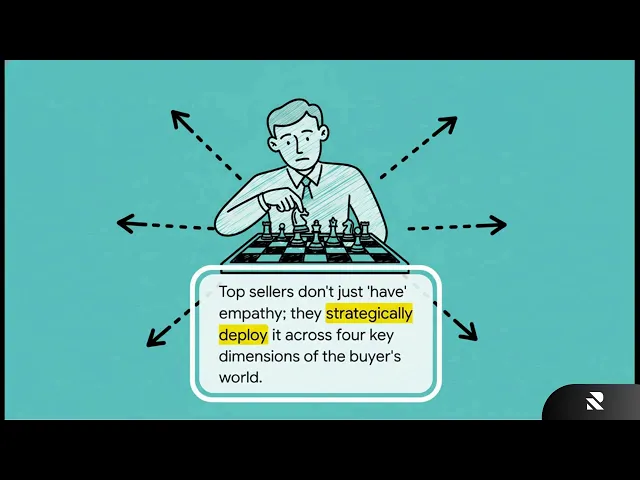
Top-performing sellers deploy empathy across four dimensions, each generating measurable commercial impact.
1. The Buyer’s External Pressures
Understanding:
Market dynamics
Competitive threats
Industry cycles
Regulatory forces
Customer expectations
This informs strategic alignment.
2. The Buyer’s Internal Environment
Understanding:
Role-specific incentives
Organizational politics
Cross-functional tensions
Budget constraints
Approval hierarchies
This informs deal strategy.
3. The Buyer’s Emotional Landscape
Understanding:
Fear of making a wrong decision
Risk sensitivity
Personal career stakes
Stress from internal visibility
Apprehensions about change
This informs momentum and trust-building.
4. The Buyer’s Cognitive Process
Understanding:
How they evaluate evidence
How they make decisions
What clarity they need
What alternatives they compare
What tradeoffs they’re weighing
This informs prescription and presentation.
Why Empathy Directly Impacts Revenue
Empathy accelerates deals through three commercial mechanisms:
Mechanism 1: Better Problem Diagnosis
When sellers understand the buyer’s role, pressure, and internal dynamics, they diagnose more accurately — which makes prescriptions more effective.
Mechanism 2: Lower Perceived Risk
Empathy surfaces unspoken fears. Addressing these proactively increases buyer confidence.
Mechanism 3: Increased Stakeholder Alignment
Empathy reveals how different internal personas evaluate decisions differently, enabling the seller to architect consensus rather than chase it.
A Framework for Operationalizing Empathy in Sales
Below is a structured model to convert empathy from an abstract concept into a scalable revenue skill.
Step 1: Build a Buyer Psychology Map
Document for each persona:
Pressures
Goals
Metrics
Fears
Incentives
Constraints
Decision style
This becomes a tactical asset for calls, messaging, and proposals.
Step 2: Use High-Resolution Discovery
Move beyond problem statements to uncover:
Context
Impact
Interdependencies
Internal stakeholders
Hidden risks
Emotional drivers
Empathy is built through precision, not guesswork.


Step 3: Validate, Don’t Assume
Ask clarifying questions:
“Is this a fair summary of your situation?”
“What else is influencing this decision?”
“Who else will have concerns?”
Validation demonstrates accuracy and creates trust.
Step 4: Tailor the Prescription to Personal and Organizational Realities
A technically perfect solution fails if it ignores:
Approval paths
Departmental conflicts
Budget politics
Personal KPIs
Timing constraints
Empathy ensures that recommendations match the buyer’s environment.
Step 5: Manage Stakeholders Through Their Own Lens
Each stakeholder requires a different argument, level of detail, and frame.
Empathy allows sellers to orchestrate committees with precision.
Illustrative Example: How Empathy Converts a “No” Into Progress
Surface-Level Conversation:
A buyer says, “We don’t have budget.”
Low-Empathy Interpretation:
“No budget = stop the deal.”
High-Empathy Interpretation:
Could be political risk
Could be competing priorities
Could be misalignment with KPIs
Could be fear of champion exposure
Could be missing internal narratives
Could be an unquantified problem
High-empathy sellers probe, support, and guide — and often find a path forward when others exit prematurely.
Implications for Sales Leaders
Empathy must be trained rather than assumed. It should be treated as a core skill and built deliberately into onboarding and reinforced through ongoing coaching, not left to personality or intuition.
Discovery frameworks should also embed cognitive-empathy prompts. When reps are guided to understand how buyers think, decide, and interpret risk, problem accuracy rises across the entire team, not just among top performers.
Success metrics need to evolve as well. When teams reward insight rather than raw activity, behavior changes. Insight-rich reps build stronger, more durable pipelines because they understand what truly matters to the buyer.
Leaders set the tone by modeling empathy in their own internal communication. Teams mirror what they see. When leaders listen carefully, acknowledge context, and communicate with clarity and respect, those behaviors cascade outward.
The result is improved cross-functional collaboration. Reps who understand the perspectives and pressures of internal stakeholders execute more effectively, align faster, and move work forward with less friction.
Actionable Takeaways
Treat empathy as a commercial skill — not a personality trait.
Build structured persona maps to understand buyer psychology.
Use deeper discovery to reveal unspoken fears and internal pressures.
Validate your understanding — accuracy builds trust.
Tailor your prescriptions to the buyer’s political, operational, and personal context.