Process
How elite sellers reverse‑engineer commitment, risk, and influence to guide deals with precision
Why map backwards now
Modern buying committees are large, cross‑functional, and scrutiny‑heavy. On average, ~13 stakeholders are involved, 89% of purchases span multiple departments, and 86% of purchases stall at some point. Forward‑mapping a tidy step‑by‑step process rarely matches how decisions are actually made. The only reliably stable reference point is the final decision and what leadership will need to defend it. Forrester, The State of Business Buying, 2024 [close.com]
The path to that decision runs across about ten interaction channels—and more than half of buyers say they will switch suppliers if the cross‑channel experience is clumsy. That omnichannel reality means gaps, rework, and late surprises unless you reverse‑engineer the end state and work backward to design proof, alignment, and governance deliberately. McKinsey B2B Pulse 2024 [my.idc.com]
Anchor on the last mile: what “yes” must survive
Treat the signed PO as an audited decision, not just a purchase. In most organizations, the last mile is controlled by CFO and Legal scrutiny: the CFO frequently has final decision power (79%), Legal slows or blocks 61% of purchases, and 57% of buyers expect ROI inside three months. If your proposal can’t withstand those tests, earlier “progress” is illusory. G2, 2024 Buyer Behavior Report [databox.com]
Technical defensibility matters just as much. Only ~28% of enterprise apps are connected on average; 81% of IT leaders say data silos hinder transformation, and 95% report integration as a hurdle to effective AI. If the end state requires a clean integration and governance story, map backward and prove it early. Salesforce/MuleSoft Connectivity Benchmark 2024 [bls.gov]
A four‑question framework to reverse‑map any deal
1) What must be true for leadership to defend the decision?
List the defensibility artifacts: a crisp executive narrative, strategic alignment, independent references, and a CFO‑ready 90‑day outcome plan with ranges and sensitivity. Owning these early avoids late “please compile a business case” detours that kill quarter‑end momentum. Forrester 2024; G2 2024 [close.com] [databox.com]


2) Who must feel comfortable signing off—and who shapes that comfort?
Map approval comfort beyond titles. The signer’s confidence is often shaped by Finance, Legal, Security, Operations, and trusted internal advisors who don’t appear on the org chart. Your plan should show how each group’s risks are addressed and how messages will travel across ten channels without distortion. McKinsey 2024 [my.idc.com]
3) Which risks must be neutralized before commitment?
Classify risks: technical (integration, data), financial (payback variance), operational (cutover, capacity), reputational/compliance (privacy, audit). Then specify the evidence each function needs (e.g., data‑flow diagrams and audit logs for Security; TCO ranges and a 90‑day outcome for Finance). This is how you prevent late CFO/Legal vetoes. G2 2024; MuleSoft 2024 [databox.com] [bls.gov]
4) What proof must exist—and when?
Buyers rarely commit on belief. Define proof points up front: pilots that validate the riskiest integration, phased rollouts with success metrics, role‑based access models, and third‑party references. Sequence them before the internal ask reaches CFO/Legal so proof supports the decision rather than delaying it. Forrester 2024; McKinsey 2024 [close.com] [my.idc.com]
From backward insight to forward control
Pre‑wire the last mile. Book a CFO/Legal prep touch before finalization; bring the ROI ≤ 90‑day path and governance artifacts. It’s faster than rework after a stall. G2 2024 [databox.com]
Design proof, don’t wait for it. If 95% cite integration hurdles, specify the pilot’s exit criteria to prove the biggest integration or data‑governance risk early. MuleSoft 2024 [bls.gov]
Make your case travel‑ready. Create a one‑page executive narrative, a finance mini‑memo (TCO ranges and sensitivities), and a technical appendix (architecture, data flows, logging). This prevents message decay across ten channels. McKinsey 2024 [my.idc.com]
Questions that reveal the real process fast
“What will leadership need to see to feel confident in 90 days?” [databox.com]
“Where do similar decisions typically get challenged internally?” [close.com]
“Which integration or compliance risks would make Legal or Security uneasy?” [bls.gov]
“Who needs to be comfortable even if they don’t sign?” [my.idc.com]
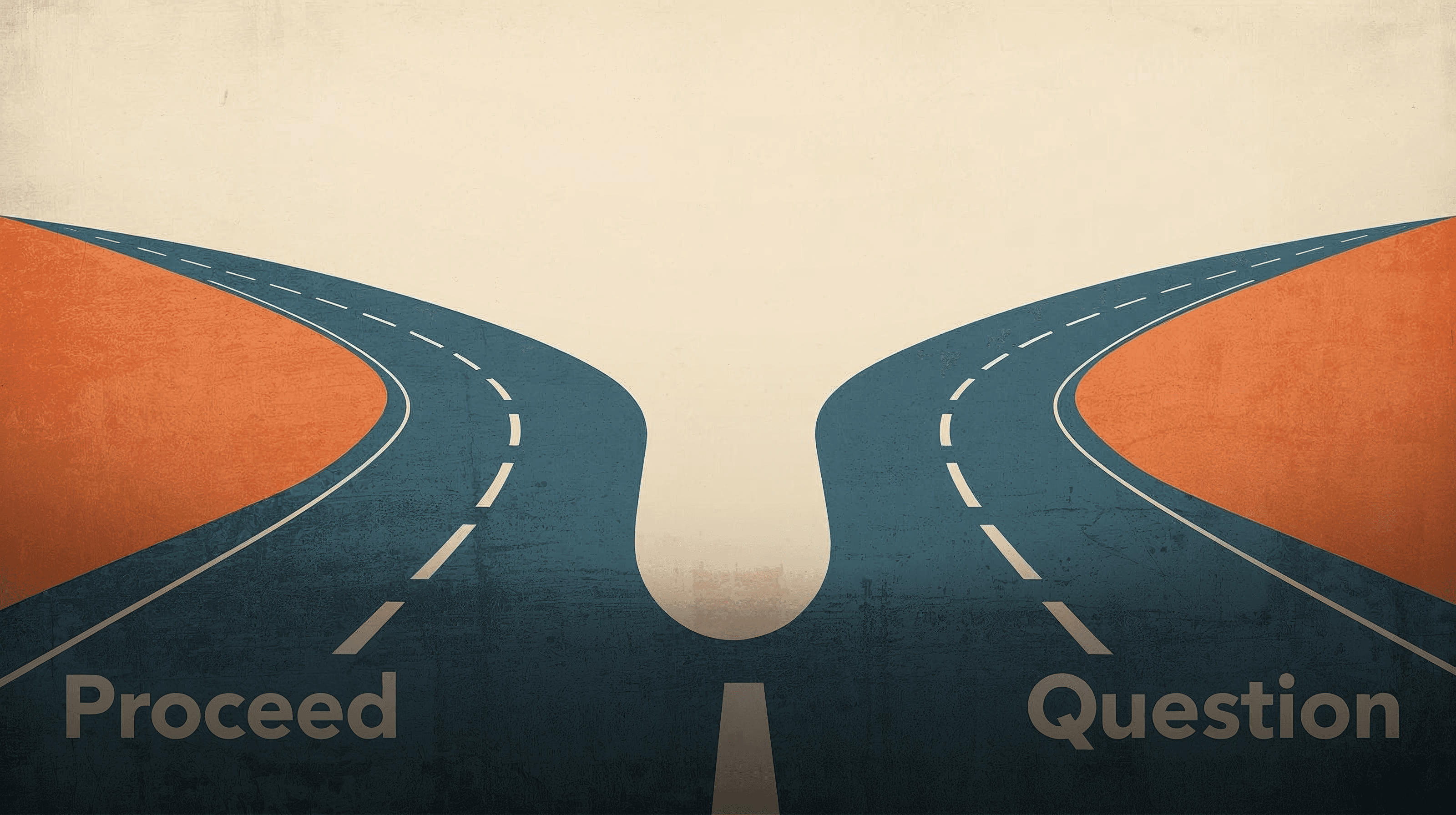
Forward‑mapping chases steps. Backward‑mapping engineers decisions. In committees of ~13 that move across ten channels, the shortest path to “yes” is to start at the end, define what a defensible decision must look like to CFO, Legal, and IT, then build the proof and alignment that make that decision inevitable. Forrester 2024; G2 2024 [close.com] [databox.com]