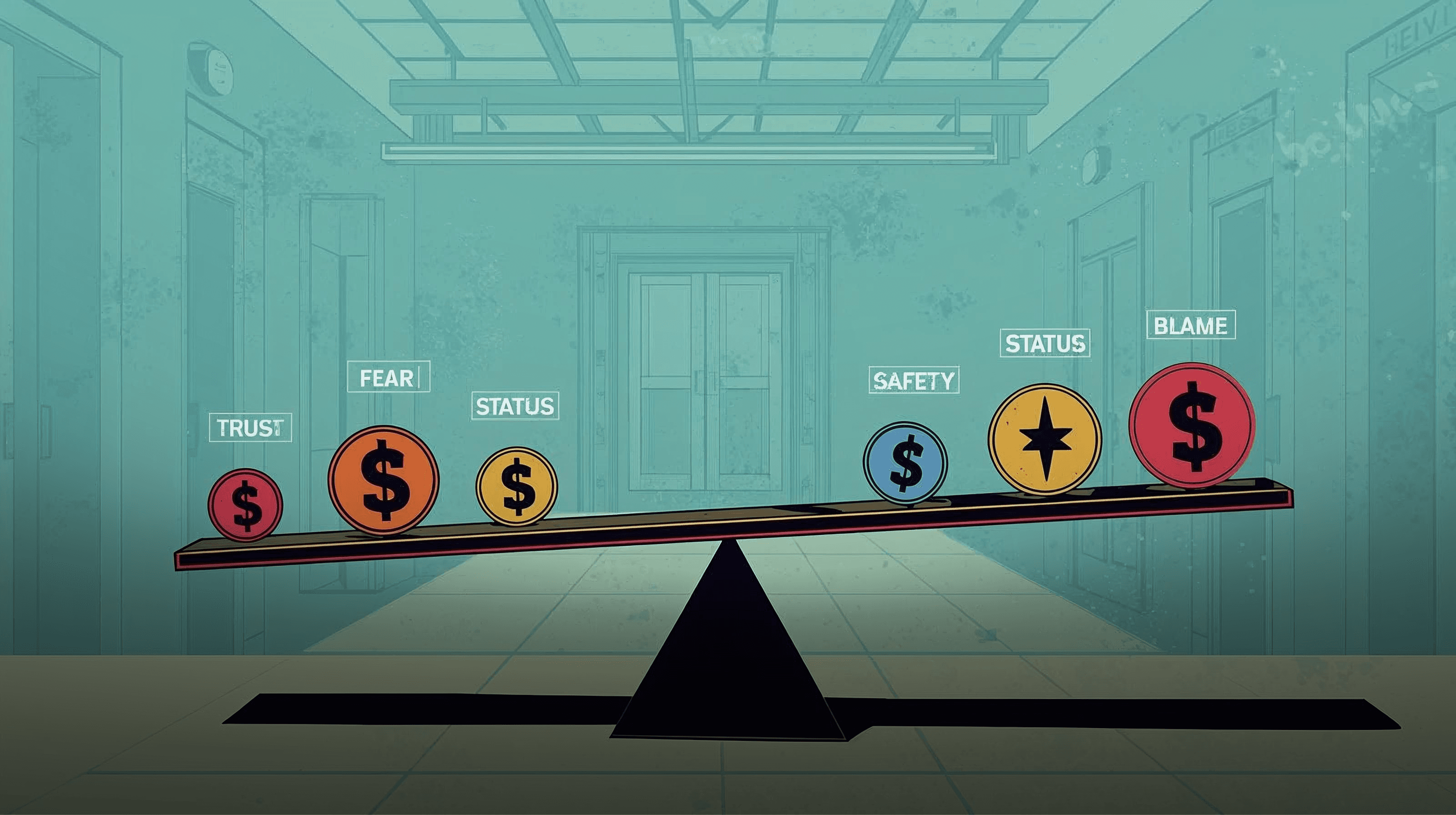
People
Buying Decisions Are Now Psychological, Not Just Procedural
Modern B2B buying is no longer a neat, linear journey with a single approver. It is a multi‑actor psychological negotiation across functions, channels, and time, in which each stakeholder brings distinct incentives, fears, and mental shortcuts to the table. The data validate the shift: the average B2B purchase involves ~13 stakeholders, 89% of purchases span multiple departments, and 86% of purchases stall at some point—a picture that screams “alignment problem,” not “process problem.” [forrester.com]
This complexity is magnified by how buying now happens. Decision makers use about ten interaction channels on average, and more than half say they will switch suppliers if the experience across those channels is clumsy. Said differently: if your rationale doesn’t survive a buyer’s email thread, Slack debate, procurement portal, and steering‑committee deck, it probably won’t survive at all. [mckinsey.com]
Implication: Sellers who understand how each role reaches “yes”—and orchestrate those psychologies into a single, defensible decision—outperform peers who treat buying as a generic “procurement process.” [forrester.com]
Deals don’t fail because of objections; they fail because of misalignment
Across pipeline reviews, stall patterns rhyme. Sellers celebrate early enthusiasm and fast demos, only to hit a wall when new stakeholders enter with basic, unresolved concerns. That shouldn’t surprise us. Late‑stage gates are real: in software, the CFO frequently has final decision power (79%), Legal slows or blocks 61% of purchases, and 57% of buyers expect ROI within three months—pressure that exposes any earlier misalignment. [wwps.microsoft.com]
Layer in the reality that buyers traverse ~10 channels, and you get lots of motion with little convergence unless the messaging speaks to each role’s yes‑criteria. [mckinsey.com]
Every decision maker says “yes” for different reasons
Below are four dominant decision‑maker archetypes and how each reaches “yes.” These patterns repeat across industries because they map to incentives, risk posture, and worldview—not to a single company’s org chart.
Important: Use these archetypes together. Most enterprise decisions require all four to be satisfied, which is why multi‑threading and message orchestration matter so much in committees averaging ~13 people. [forrester.com]
Archetype 1 — The Financial decision maker
CFO, Finance VP, Controller, Procurement
What they care about
Efficiency, predictability, ROI, risk mitigation, and total cost of ownership (TCO). The climate favors them: shortlists are shrinking and ROI clocks are shorter, so finance scrutiny has intensified. [wwps.microsoft.com]
Their psychological lens
Finance says “yes” when uncertainty falls and economic advantage is provable (even with ranges). They are the last‑mile veto if the path to value within ≤ 90 days is not credible. [wwps.microsoft.com]
Hidden fear
Unexpected financial exposure (runaway OPEX, surprise services, sunk‑cost regret).
How to earn their “yes”
Quantify impact with ranges, not perfection; show sensitivity (best/likely/worst). Finance values honesty about variance more than polished claims. [wwps.microsoft.com]
Present TCO instead of price: include integration, training, support, and risk avoidance. Data silos and low data confidence are costly; cite their downstream risk. [salesforce.com], [ibm.com]
Design a conservative, staged path to a first measurable outcome inside a quarter. [wwps.microsoft.com]
How they hear “features” → Cost.
How they hear “prescriptions” → Control (predictability, bounded risk).
Proof points that land with Finance: buyers switching over poor omnichannel experiences (a churn risk), and the real cost of data problems. Use McKinsey’s switching data and IBM’s losses from bad data to frame the financial downside of inaction. [mckinsey.com], [ibm.com]
Archetype 2 — The Operational decision maker
COO, Ops Director, Supply Chain Lead, Customer Support Manager
What they care about
Speed, reliability, workload reduction, error rate, and “won’t break my day.” In multi‑channel operations, complexity increases fatigue; 32 workdays/year are lost to app‑switching alone, so ops leaders love anything that reliably removes friction. [deloitte.com]
Their psychological lens
Operators say “yes” when the path clearly eliminates bottlenecks and is easy to implement. They value clarity over elegance and certainty over novelty.
Hidden fear
Operational disruption that backfires on their teams—even small disruptions.
How to earn their “yes”
Show the before/after workflow with steps, owners, and failure modes removed; quantify time saved (and reclaimed focus) to ground the business case. [deloitte.com]
Provide a low‑friction rollout (pilot design, cutover plan, hypercare), and pre‑empt hand‑off risks in ~10‑channel journeys. [mckinsey.com]
Keep strategy light; anchor to execution outcomes (SLA adherence, touches per item, error rate reductions).
How they hear “features” → More work.
How they hear “prescriptions” → Simplicity (fewer steps; fewer surprises).
Archetype 3 — The Strategic decision maker
CEO, BU Leader, SVP, Transformation Lead
What they care about
Growth, competitive advantage, future‑proofing, scalable models, and reputation. They invest when the initiative strengthens long‑term position and aligns to transformation goals.
Their psychological lens
Strategic leaders say “yes” when the narrative creates future‑proof advantage and shows how the company wins across markets. They want the why, not all the how.
Hidden fear
Being outpaced by competitors or locked into outdated systems.
How to earn their “yes”
Tie outcomes to strategic KPIs (growth, time‑to‑market, category differentiation), not only operational metrics.
Place the plan in the context of the current buying reality: omnichannel is table stakes; more than half of buyers will switch suppliers for a smoother cross‑channel experience. Strategic leaders need to see how this investment keeps them on the right side of that preference. [mckinsey.com]
Keep detail light; provide a striking throughline and a credible phased path (e.g., 90‑day milestones, then scale).
How they hear “features” → Noise.
How they hear “prescriptions” → Vision (positioning, advantage, pacing).
Reinforce with trusted content: Thought leadership influences executives’ perceptions and prompts them to explore vendors they weren’t considering—75% of decision makers say high‑quality thought leadership spurred new research. Use it to set the strategic frame. [ragan.com]
Archetype 4 — The Technical decision maker
CIO, CTO, Security Lead, IT Director, Compliance Officer
What they care about
Security, integration, reliability, compliance, scalability, and technical debt avoidance. Their environment is stretched: only ~28% of apps are integrated on average, 81% say data silos hinder transformation, and 95% cite integration as a hurdle to AI adoption. They will not add more fragility. [salesforce.com]
Their psychological lens
Technical leaders say “yes” when a solution fits the architecture, reduces risk, and doesn’t create debt. They are gatekeepers because cross‑functional choices ripple into reliability and cost.
Hidden fear
Security incidents, fragility from tight coupling, maintenance burdens that outlive sponsors.
How to earn their “yes”
Show architectural compatibility and clear data flows; specify identity, encryption, logging, and audit.
Acknowledge the integration reality (few apps connected; silos common); explain how you minimize coupling and support API‑centric patterns. [salesforce.com]
Provide governance scaffolding (role‑based access, change control), and address compliance. Technical leaders will sponsor solutions that lower risk.
How they hear “features” → Risk.
How they hear “prescriptions” → Safety (fit, controls, reversibility).


Why this framework works: it mirrors how committees actually decide
Committees do not decide collectively; individuals decide psychologically, then negotiate a shared outcome. Your job is to orchestrate a “yes” that meets each role’s non‑negotiables:
Finance: Defensibility, ROI ≤ 90 days, bounded risk. [wwps.microsoft.com]
Operations: Simplicity, reliability, minimal disruption. [deloitte.com]
Strategy: Advantage, relevance to priorities, credible phasing. [mckinsey.com]
Technology: Fit, security, integration, observability. [salesforce.com]
A seller who integrates these psychologies becomes an orchestrator—reducing stall risk in a world where 86% of purchases otherwise do. [forrester.com]
Persona‑specific playbooks (with messaging, metrics, and proof)
Use the following as building blocks for discovery, proposals, and internal enablement. Each block is designed to travel across the ~10 channels a modern committee uses. [mckinsey.com]
1) Financial playbook
Discovery prompts
“Which costs matter most to Finance (run‑rate, support, rework, risk)?”
“What does a credible ≤ 90‑day outcome look like to your CFO?” [wwps.microsoft.com]
Metrics to highlight
TCO over 1–3 years; sensitivity ranges.
Hard savings (licenses, rework hours) + risk reduction (audit, churn, breach exposure). Poor data quality alone hits many firms for >$5M/year—use ranges to quantify avoided loss. [ibm.com]
Artifacts
CFO‑ready one‑pager: baseline → 90‑day outcome → TCO → sensitivities → risk controls.
Omnichannel churn risk (buyers switching over poor digital experiences) as a financial downside. [mckinsey.com]
2) Operational playbook
Discovery prompts
“Show me the exact step where work waits. Who owns it? What rework follows?”
“If we removed X touches or automated Y checks, what else speeds up?”
Metrics to highlight
Touches per item; cycle time; error rate; hours saved per week.
Capacity lift framed against the 32 lost workdays/year toggle tax to avoid overclaiming. [deloitte.com]
Artifacts
Before/after swimlane; pilot plan; hypercare schedule; SLA dashboard sketch.
“Day‑0 changes” list to reassure teams about disruption.
3) Strategic playbook
Discovery prompts
“Which strategic KPIs do we impact in 12–24 months?”
“Where are competitors moving faster—and how does this investment bend your curve?”
Metrics to highlight
Market share, time‑to‑value, launch cadence, customer experience indicators (e.g., reduced switching risk across channels). [mckinsey.com]
Artifacts
Narrative brief: why now → advantage created → phased path.
Link to credible thought leadership (more trusted than marketing by executives; 75% say it prompts product research). [ragan.com]
4) Technical playbook
Discovery prompts
“Which systems are touchpoints, where are the brittle couplings, and what’s your data‑governance posture?”
“What risk do we remove (not add) across integration, identity, and audit?”
Metrics to highlight
Reduced integration points; standardized interfaces; MTTR improvements; audit coverage.
Reference the integration reality: ~28% of apps connected on average; 81% say silos hinder transformation; 95% cite integration hurdles for AI. [salesforce.com]
Artifacts
High‑level architecture; data‑flow diagrams; IAM/segregation of duties; logging and observability plan; compliance checklist.
Putting it together: one opportunity, four yes‑paths
When you craft a proposal, build four thin storylines around one core throughline.
Throughline (applies to all): The business problem, the recommended path, and the 90‑day outcome. Then, tailored sections:
Finance gets the TCO and sensitivity ranges, plus a credible ≤ 90‑day ROI milestone. [wwps.microsoft.com]
Operations gets the before/after workflow and rollout plan that avoids disruption. [deloitte.com]
Strategy gets the narrative of advantage and how omnichannel realities make this table stakes. [mckinsey.com]
Technology gets architecture, integration boundaries, and governance scaffolding that reduce risk in a landscape where silos impede AI and transformation. [salesforce.com]
Deliver these as copy‑ready slides your champion can paste into internal decks. In committees of ~13, clarity that travels is a competitive moat. [forrester.com]
Management systems that reinforce persona psychology
1) Multi‑threading by design
Measure outreach not by “contacts” but by role coverage: Finance + Ops + Strategy + Tech. This lowers stall risk in the 86% of purchases that otherwise bog down. [forrester.com]
2) Forecasts that score “decision readiness”
Add fields for: problem‑statement stability, decision owner, tradeoffs decided, CFO/Legal engagement, and data‑confidence (are silos addressed?). Accuracy improves when you track uncertainty reduction, not just velocity. [salesforce.com], [forrester.com]
3) Content that educates each archetype
Publish short thought‑leadership pieces that speak to each role’s concerns; they are more trusted than marketing and can prompt out‑of‑market buyers to reconsider vendors. [ragan.com]
4) Governance that matches CIO/CTO risk
Include a one‑page governance appendix (access controls, logging, audit, change management). In a world where only ~28% of apps are connected and 81% cite silos as blockers, perceived safety is often the difference between “not now” and “go.” [salesforce.com]
Illustrative scenario: the same demo, four different “yes” paths
A growth‑stage company is buying an analytics platform.
Finance balks at list price—until they see TCO with integration consolidation, risk‑avoidance from eliminating data silos (a multi‑million‑dollar annual exposure for many firms), and a ≤ 90‑day adoption milestone tied to churn reduction. [salesforce.com], [ibm.com]
Operations feared disruption—until the seller showed a one‑sprint pilot, before/after workflows, and a hypercare plan that reduces manual reporting and context switching (a 32‑day annual drain). [deloitte.com]
Strategy wanted differentiation—so the narrative framed faster omnichannel insights that protect against supplier switching risk and enable quicker market tests. [mckinsey.com]
Technology worried about debt—until the architecture diagram, API plan, and data‑governance model showed reduced coupling and clear observability in an environment where 95% cite integration hurdles for AI. [salesforce.com]
The same product. Four tailored stories. One credible “yes.”
Implications for sales teams
1) Multi‑threading becomes more effective.
Reps approach each conversation with persona‑specific value, not generic features—vital when shortlists are shrinking and CFO scrutiny is rising. [wwps.microsoft.com]
2) Forecast accuracy improves.
When you assess decision readiness (owner, tradeoffs, CFO/Legal engagement, data confidence), your commits reflect reality in a market where 86% of deals stall. [forrester.com]
3) Champions gain internal influence.
Give them copy‑ready pages for each role; executives report that thought leadership and rigorous rationale influence vendor reconsideration. [ragan.com]
4) Competitive differentiation increases.
Most sellers sell features. Elite sellers sell alignment—and win in committees of ~13 across ~10 channels. [forrester.com], [mckinsey.com]
Actionable takeaways
Identify the archetypes early. Map Finance, Ops, Strategy, Tech by name during first discovery; don’t wait for late‑stage surprises. The composition is predictable at ~13 stakeholders. [forrester.com]
Tailor messaging to each lens. Finance = ROI/TCO/≤90 days; Ops = workflow and rollout; Strategy = advantage; Tech = fit and governance. [wwps.microsoft.com], [deloitte.com], [mckinsey.com], [salesforce.com]
Anchor to outcomes that matter. Use omnichannel switching risk, data‑silo costs, and toggle‑tax baselines to quantify impact credibly. [mckinsey.com], [ibm.com], [deloitte.com]
Equip champions with persona‑specific one‑pagers. Great content travels across ~10 channels and reduces reinvention as new stakeholders join. [mckinsey.com]
Use prescriptions, not feature lists. Recommendations reduce cognitive load and align divergent yes‑criteria faster than capabilities alone. (And they’re what CFO/Legal ultimately approve.) [wwps.microsoft.com]
Deals aren’t won by persuading a single “buyer.” They’re won by engineering concurrence across Finance, Operations, Strategy, and Technology—each with distinct psychology and veto power. In committees averaging ~13 people and journeys spanning ~10 channels, the seller who understands how each role says “yes”—and designs a decision that satisfies them all—turns complexity into a competitive advantage. [forrester.com], [mckinsey.com]
Sources
Forrester: The State of Business Buying, 2024 (stakeholders, cross‑department, stall). Pressroom [forrester.com]
McKinsey: B2B Pulse 2024 (ten channels; switching risk). Article [mckinsey.com]
G2: 2024 Buyer Behavior Report (CFO final say 79%; Legal 61%; ROI ≤ 90 days). Business Wire summary [wwps.microsoft.com]
Deloitte: Productivity+ (toggle‑tax; 32 workdays lost). Perspective [deloitte.com]
Salesforce/MuleSoft: Connectivity Benchmark 2024 (data silos 81%; 28% apps connected; 95% integration hurdles for AI). Newsroom [salesforce.com]
IBM Institute for Business Value: The True Cost of Poor Data Quality (>$5M/year losses common). Report [ibm.com]
Edelman–LinkedIn: 2024 B2B Thought Leadership Impact Report (trust and purchase exploration). Report and coverage [edelman.com], [ragan.com]