Solution Focus

From Objection Handling to Opportunity Engineering
For decades, sales teams treated buyer objections as hurdles to overcome – a defensive exercise in rebuttal. But modern buyers have changed. They’re more informed (often completing 50–70% of their buying journey independently), more skeptical, and more accountable within their organizations. Indeed, only 29% of buyers say they trust salespeople (ranking them below lawyers and just above car dealers). They don’t want a hard sell; they want insight and partnership. It’s no surprise that 72% of top-performing salespeople now use a “buyer-first” approach that prioritizes the buyer’s needs over a generic pitch. In this new paradigm, objections aren’t something to “overcome” or push aside – they’re something to analyze and leverage. [marketingscoop.com] [blog.hubspot.com]
Today’s high-performing sellers view objections not as barriers but as information assets. Each objection is a clue about the buyer’s internal calculus: their concerns, constraints, and priorities. Instead of bracing for conflict when a prospect pushes back, elite reps lean in with curiosity. Conversation analysis backs this up: when faced with an objection, average sellers tend to launch into a premature pitch or argument. But top reps ask a follow-up question 54% of the time, versus only 31% for weaker reps. In other words, the best sellers interpret pushback as valuable data and seek to decode it, whereas average sellers either deflect it or steamroll it. [slideshare.net]
This shift reflects a deeper change in the buying environment. B2B buyers are more educated (often downloading content and comparing alternatives long before engaging sales) and face greater scrutiny on their decisions. Many are held accountable by diverse buying committees – the average B2B buying group now involves 8.2 stakeholders, up from 6.8 just a few years ago. Their objections are rarely as simple as “I don’t like your product.” More often, they stem from uncertainty, internal misalignment, or perceived risk. Buyers might be thinking: “If this fails, it’s on me,” “How do I sell this internally?,” or “Is now the right time amid other priorities?” By treating objections as useful signals rather than unwelcome interruptions, sellers can uncover these hidden dynamics and address them head-on. [marketingscoop.com]
Most Deals Don’t Die From “No”; They Die From Untranslated Pushback
Experienced sales leaders know that outright “no’s” are not the biggest problem – indecision is. Studies of B2B sales cycles show that a huge portion of potential deals fail due to no decision. In fact, a Harvard Business Review analysis of 2.5 million sales conversations found 40% to 60% of deals end in no-decision. Similarly, in a recent survey nearly 86% of B2B buyers admitted that a purchase had stalled out during their buying process. In other words, most deals don’t blow up in a fiery “no” – they quietly fade because the buyer’s hesitations were never fully resolved. The status quo or competing priorities win by default. [hbr.org] [sopro.io]
Why does this happen? Often, it’s because:
The seller misinterprets buyer resistance. When a prospect raises a concern, many reps either give a shallow answer or assume it’s a smokescreen, rather than digging deeper. There’s frequently a mismatch between what the buyer really meant and what the seller heard. Research confirms this disconnect – in one analysis, 50–70% of the time buyers and sellers cited different reasons for a deal being lost. Sellers often blame price, budget, or product issues, while buyers talk about internal factors or lack of clarity. In short, the rep might be fighting the wrong battle. [corporatevisions.com]
The underlying concern remains unspoken. Buyers, especially in complex sales, may voice a convenient objection (“We don’t have budget”) that conceals the true issue (e.g. “we haven’t secured CFO approval” or “another department leader isn’t on board”). If the rep takes the statement at face value and moves on, the real roadblock stays hidden. One win-loss study found 53% of “lost” deals were actually winnable – the deciding factor was a misstep or an unaddressed issue in the sales process. In many cases, the rep never uncovered the issue that ultimately killed the deal. [corporatevisions.com]
The seller goes into defense mode instead of exploration. It’s human nature – an objection can feel like an attack, and salespeople may get defensive or push back immediately with facts and arguments. This “fight-or-flight” reaction is exactly the wrong approach. Psychologically, when a person’s concern isn’t heard, they tend to retreat. If a seller responds to “I’m not sure this will work for us” with “Let me tell you why it will” – without first understanding why the buyer feels that way – the buyer will likely disengage further. The opportunity to build trust is lost.
The buyer feels unheard and unsure. People want to feel understood, especially when making a big decision. If a buyer raises an issue and the seller glosses over it, the buyer’s confidence in that seller drops. They may start doubting whether the rep truly cares about solving their problem or just wants to make a sale. That emotional dynamic can poison the deal even if all factual questions are answered. According to Gartner, B2B customers who feel their concerns are inadequately addressed experience significantly higher “purchase regret” post-decision – which often translates to them opting not to decide at all. [challengerinc.com], [challengerinc.com]
The risk remains unaddressed. Behind every objection is a risk the buyer is worried about. It could be career risk (choosing a solution that fails), financial risk, or operational risk. If the seller doesn’t identify and mitigate that specific risk, it remains a powerful, if unspoken, deal-killer. A recent Gartner and Challenger survey revealed that “gaining buyer commitment” – essentially overcoming indecision – was the number one challenge cited by sales professionals (60% of sellers, up from the previous year). Buyers often aren’t saying “no”; they’re saying, “not comfortable enough to say yes.” [challengerinc.com], [challengerinc.com]
Momentum quietly evaporates. The final stage of a stalled deal is usually radio silence or endless delays. The prospect doesn’t explicitly reject the proposal; they just stop responding or continuously push out the decision. Internally, their doubts haven’t been resolved, so taking action keeps getting deferred. The Salesforce “State of Sales” report notes that nearly 9 in 10 buyers ultimately feel dissatisfied with their buying process – a telling statistic that indicates how many sales processes drift into oblivion or regret. From the seller’s perspective, the deal simply “goes dark.” [sopro.io], [sopro.io]
The result of all this is a silent exit: indecision, delay, or disappearance. No phone call saying “we chose a competitor” – just an opportunity that never closes. To prevent this fate, sellers must learn to translate pushback into the real issues and proactively address them. That means developing the skill to convert objections into actionable intelligence.
When reps master this, the impact is dramatic. They stop losing by default and start winning deals that would otherwise vanish. They maintain control of the sales process by continually surfacing and solving the buyer’s concerns. Crucially, they turn moments of resistance into deeper engagement, showing the buyer that they are heard and helped. The key is a mindset shift: view every objection as a clue, not a verdict.
Pushback Is a Map, Not a Wall
There’s a saying in sales: “The first objection is never the real objection.” Behavioral economics and decision science back this up. When people encounter friction or doubts, what they voice is often a symptom, not the root cause. It’s like a patient describing pain – the pain is real, but the doctor’s job is to find the underlying condition.
Research in buyer psychology shows that most stated objections mask deeper concerns. One consulting study estimated that approximately two-thirds of buyer objections aren’t truly about price or features at all – they stem from underlying psychological or organizational barriers. In other words, a prospect might say “Your price is too high,” but the real issue could be fear of making a bad investment, uncertainty about internal ROI justification, or a prior bad experience with a similar vendor. The price objection is a proxy for these deeper anxieties. [lunas.consulting]
Consider some common pushback phrases and what they often signify beneath the surface:
“Now isn’t the right time.” Surface meaning: timing/priority issue. Underlying signals: The buyer may be experiencing cognitive overload or competing initiatives. Perhaps they feel their plate is too full to champion a new project (a classic symptom of friction). Or politically, they worry that pushing this now could be risky if other projects outrank it. In fact, when researchers at DCM Insights analyzed “no decision” deals, they found buyers’ hesitation was usually not because they didn’t see value – it was because they feared disruption or failure in the current moment. Translation: “I’m not confident I can take this on successfully right now.” [sharpstance.com]
“We’re evaluating alternatives.” Surface meaning: considering competitors. Underlying signals: Often, this is an all-purpose stalling phrase. It might hide uncertainty about your solution’s fit or internal alignment issues (e.g., another stakeholder prefers a different approach). It could also reflect a need for more information – the buyer isn’t yet convinced and is still researching. Behavioral science tells us people often seek more options when they feel unsure; paradoxically, too many options then cause analysis paralysis. If a buyer is continuously “evaluating,” they may actually be asking you for clarity or differentiation to break the logjam. [sharpstance.com]
“The team isn’t aligned.” Surface meaning: internal disagreement. Underlying signals: This points to political concerns. Perhaps one department head is unconvinced, or someone influential is resisting change. It might also indicate the absence of a strong internal champion pushing the deal. (Note: Large buying groups are the norm now – as mentioned, around 8 people on average – and internal misalignment is a top reason for deal inertia. Gartner data shows that as the number of decision-makers rises, the likelihood of a purchase happening drops sharply – from 81% when 1–2 stakeholders are involved down to just 31% with 5+ involved.) Translation: “You need to help us get consensus – or this will die internally.” [marketingscoop.com]
“We don’t have budget.” Surface meaning: can’t afford it. Underlying signals: “No budget” is often a socially acceptable way to say “I can’t get this approved right now.” The real obstacle might be the business case – perhaps the buyer isn’t convinced the problem is big enough to warrant reallocated funds, or they fear the ROI won’t satisfy Finance. It could also hint at timing (the budget cycle is mid-year and unplanned projects face a hurdle). Many times, it means “I haven’t sold this upward in the organization.” It’s worth noting that in ~79% of corporate purchases a CFO or finance executive must give the green light, and in ~61% a legal or procurement team will scrutinize the deal. If those gatekeepers aren’t on board, a line-manager buyer will understandably say “budget isn’t there” rather than “I couldn’t convince the CFO.” [sopro.io]
“I’m not fully convinced this will work for us.” Surface meaning: skepticism about product effectiveness. Underlying signals: This is a credibility and risk concern. The buyer is essentially saying they aren’t sure your solution will deliver as promised in their specific environment. They might need proof in the form of case studies, pilot results, or references. Or it could be a trust issue – maybe you haven’t demonstrated enough understanding of their situation, so your recommendations seem generic. Psychologically, buyers are often hesitant due to loss aversion – the fear of making the wrong decision looms larger than the potential gains of the right decision. So “I’m not convinced” often really means “I fear this could fail or cause me pain.” Addressing that requires de-risking the proposal (through guarantees, trials, evidence, etc.), not just repeating the value proposition. [lunas.consulting]
The key insight for sellers is that when you treat the surface objection as the actual problem, you risk responding to the wrong issue. If you take “no budget” at face value, you might say “we can offer a discount” – but price wasn’t the real barrier at all, and now you’ve just devalued your solution unnecessarily. Or if the prospect says “we’re looking at competitors” and you start a feature war, you might miss that the real worry is an internal one that no amount of feature-bullet-pointing will solve.
On the other hand, when you treat objections as directional indicators, you can navigate toward the true blockages in the deal. Each objection is like a signpost. Instead of seeing it as a wall (“They said no, end of story”), see it as a map (“They’re pointing to where they feel pain or risk”). For example, a flurry of “how will this work with our existing system?” questions might indicate the buyer’s team is anxious about implementation complexity – a cue to provide a detailed onboarding plan or offer a pilot, rather than just saying “it’s easy to use.”
In short: pushback contains the highest-value information in a deal – if you know how to decode it. It often reveals exactly what you must solve for the buyer to move forward. Rather than resisting the pushback, top sellers pivot to explore it. They know an objection is never just a “no” – it’s an invitation to diagnose the deal’s reality.
Why Pushback Contains the Highest-Value Information in a Deal
Let’s break down three reasons objections are goldmines of insight:
1. Pushback Reveals Hidden Constraints. Many factors influencing a B2B deal’s outcome are invisible to the seller: internal politics, budget frameworks, personal incentives, risk appetite, competing projects. Objections are one of the only windows a seller gets into these behind-the-scenes drivers. For example, if a buyer keeps asking about data security or contract terms, it signals their legal team’s concerns (perhaps revealing a hidden constraint around compliance). If they say “we lack budget,” it may reveal a funding constraint or priority call you weren’t aware of. In fact, buyers spend only ~17% of their total buying time meeting with potential vendors; the rest is spent on internal deliberations, research, and approvals. Thus, the few clues they give you – often in the form of objections or pointed questions – are incredibly valuable. They surface the roadblocks you’d otherwise never see. A savvy seller realizes that an objection about, say, ROI justification likely means the seller will need to help the champion build a business case for senior management. In one striking example, a sales VP analyzing won vs. lost deals found that deals with a strong internal champion (who helped navigate these hidden constraints) closed 2X faster and with more than double the win rate of deals without a champion. And what signals the presence or absence of such a champion early on? Often, the nature of objections (e.g., “the team isn’t aligned” is a red flag that no one internally is driving consensus). In short: objections shine light on the otherwise dark corners of a buyer’s decision process. [marketingscoop.com] [resources.rework.com] [marketingscoop.com]
2. Pushback Reflects the Buyer’s Internal Debate. Think of an objection as a snapshot of the internal dialogue the buyer is having with colleagues and with themselves. By the time a buyer voices a concern to you, they’ve probably discussed it privately or mulled it over. For instance, if a prospect says, “We’re not sure if this will integrate with our current system,” you can bet this topic came up in an internal meeting (“Will this play nicely with our tech stack?”). Or a hesitant “Is this really a priority for us right now?” likely echoes conversations happening in their organization about competing initiatives. Researchers from Gartner have noted that in complex B2B sales, customers must navigate an ever-growing group of stakeholders and opinions – the latest data shows 8.2 stakeholders on average in a buying group, each with their own criteria and concerns. Every objection you hear tends to originate from one of those actors or collective deliberations. Thus, when the buyer voices it to you, they are essentially allowing you to eavesdrop on the internal decision-making process. That’s incredibly valuable! It tells you where the debate is. Are they hung up on implementation details? ROI? Political turf wars? Once you know, you can equip your champion with the right information, or engage additional stakeholders, or tailor your value proposition to address that exact debate. In a very real sense, objections map out the decision architecture of the deal – showing you who and what is influencing it. Great sellers welcome these flashes of transparency, because it lets them proactively address the real decision drivers rather than guessing. [marketingscoop.com]
3. Pushback Signals Where the Buyer Needs Support. Every objection is effectively the buyer saying, “I need help with X to feel comfortable moving forward.” If a prospect says, “I don’t see the ROI,” they are implicitly asking you to provide a compelling financial justification – maybe via case studies, ROI calculators, or a pilot program that proves the value. If they say “we’re not aligned internally,” they are signaling that you may need to facilitate alignment – perhaps by meeting with the broader team, providing use-cases for each stakeholder, or arming an internal champion with talking points. In this way, objections are like an instruction manual for advancing the deal: they point directly to the next tasks you, the seller, must accomplish. Contrast this with a situation where the buyer is silent and seemingly agreeable – you might think everything’s fine, but in reality you have unmet needs or doubts lurking. An objection brings those to the surface and essentially says, “Here’s what’s stopping us – can you help solve it?” High performers recognize this signal and pivot to problem-solving. Average performers may either get flustered or stick to a script, but the best will adapt their sales process to deliver exactly what the buyer needs. This could mean proposing a tailored next step: “I hear that the team isn’t on board yet – how about we set up a workshop with them to address concerns?” or “If you’re unsure about ROI, let’s do a small pilot next quarter – if we can prove the results, would that justify the budget?” By responding in this way, you’re not pushing the customer to overcome their objection; you’re helping the customer overcome it. That increases the buyer’s confidence and propels the sale.
To illustrate the power of using objections as a roadmap, consider a real-world example: A SaaS sales team noticed they were losing many deals when prospects said something like, “It’s not a priority right now.” On analysis, their win rate on those deals was a dismal 9%. Rather than accepting this at face value, the team dug into the root causes – discovering it was often a polite way buyers expressed uncertainty about the solution’s impact or internal support. The sales team then developed new messaging and tools to reframe the value in terms of top-line business initiatives and to create urgency. They trained reps to ask questions that uncovered the critical pain being under-prioritized. Over the next quarter, their win rate on “not a priority” deals jumped from 9% to 42% – and their overall win rate climbed to 51%, doubling revenue in six months. The turning point was systematically addressing what the objection was telling them (no clear priority = show bigger impact + build internal urgency). This example shows: when you mine objections for insight and respond accordingly, you can dramatically change outcomes. [scriptal.io], [scriptal.io]
The Obstacle Alchemy Framework: Converting Pushback Into Progress
How exactly can sellers turn objections from deal-killers into deal-advancers? Here’s a step-by-step framework – call it Obstacle Alchemy – based on what top performers do:
1. Slow the Moment – Shift from Defense to Curiosity. The first seconds after an objection are crucial. Many sellers react on impulse – the brain perceives an objection as a threat, triggering a fight-or-flight response. Average reps tend to either fight (immediately counter the objection, sometimes talking over the customer) or flight (become flustered or try to change the subject). High performers counter this impulse by deliberately pausing and dialing down their emotional intensity. They take a breath, remain calm, and respond with something like, “That’s a valid question,” or “I appreciate you raising that.” This buys a moment to collect their thoughts and signals to the buyer that they’re not defensive or rattled. Data from conversation analytics reinforces the value of this approach: After analyzing 67,000 sales call recordings, Gong.io found that top salespeople pause 5 times longer on average after hearing an objection than average performers. Where an average rep might jump in almost instantly (perhaps a half-second pause), a star rep might wait a couple of seconds before replying – a huge difference in a live conversation. Moreover, top reps maintain a steadier tone and pace; average reps tend to speed up (almost 188 words per minute) when an objection hits, whereas stars stay around their normal 175 wpm tempo. This matters because a rushed, anxious tone inadvertently communicates uncertainty or desperation, whereas a measured response projects confidence. Essentially, great reps give themselves (and the buyer) permission to slow down when an objection arises. The mindset is, “Okay, this is important – let’s explore it,” instead of “I must fix this immediately.” By slowing the moment down, you create a space for dialogue rather than a clash. The buyer feels heard rather than steamrolled. Emotionally, this also helps the rep avoid going into panic mode. Sales trainers often coach: “Stay curious, not furious.” That little pause and posture of inquiry sets exactly that tone. [slideshare.net], [slideshare.net] [slideshare.net]
2. Decode the Signal – Identify the Type of Objection. Once you’ve given yourself a beat, the next step is to figure out what category of concern you’re dealing with. In B2B sales, most objections fall into one of five buckets: Priority, Risk, Resources, Alignment, or Fit/Credibility. Is the prospect essentially saying this solution isn’t a priority right now (Priority)? Are they unsure if it will work or deliver (Risk)? Do they lack budget or personnel (Resource)? Are there other stakeholders not on board (Alignment)? Or are they questioning whether your solution is the right fit (Credibility/Fit)? Determining the category is critical because each one implies a very different strategy. For example, if it’s a Priority pushback (“not the right time”), you likely need to elevate the problem’s urgency or show why acting now is beneficial. If it’s a Risk pushback (“not sure it will work for us”), you need to provide evidence or a trial to mitigate that risk. If it’s an Alignment pushback (“team isn’t on board”), you should identify the missing stakeholders and perhaps facilitate a group discussion. Think of this step as diagnosing the illness before prescribing medicine. Here’s a telling statistic: in one company’s analysis, when prospects said “Price is too high,” that company’s win rate was only 18% – but when the main objection was “Need more features,” they won 61% of those deals. Clearly, a price objection and a feature objection require different approaches (just dropping price wouldn’t help if the issue is missing functionality, and adding features won’t close a deal where the issue is strictly budget). By rapidly identifying the objection type, top sellers tailor their response instead of defaulting to a one-size-fits-all rebuttal. They might even label it aloud: “It sounds like the main concern is whether this will integrate with your systems – is that fair?” (This acknowledges the objection and makes sure they’re decoding correctly). The faster you map an objection to its underlying type, the more effectively you can address it with the right playbook. [scriptal.io]
3. Surface the Real Issue through Clarifying Discovery. Once you’ve identified the flavor of the objection, don’t rush to answer it immediately. Instead, engage the buyer in a brief discovery dialogue to uncover the deeper specifics. This is where curiosity is your best friend. Ask open-ended, non-judgmental questions that encourage the buyer to elaborate. For example, “Can you walk me through what concerns you most about the timing?”, “What outcomes would you need to see to feel confident in the ROI?”, or “What have your internal discussions sounded like so far?” These questions serve two purposes: (a) They help you pinpoint the real barrier with precision, and (b) they make the buyer feel heard and understood. Often, you’ll find that a broad objection contains a very concrete kernel. “No budget” might actually mean “We budgeted for X, and this would need 20% more – I’m not sure how to justify that.” “Not convinced it will work” could mean “Your case studies are from different industries; we haven’t seen proof it works in ours.” You wouldn’t know that if you didn’t ask. Top performers excel here: they use an objection as a springboard into exploratory questions. Gong’s data revealed that after an objection, average performers tend to respond with a statement (often defensive) 69% of the time, whereas high performers respond with a clarifying question 54% of the time. That aligns with what sales coaches have long taught – something like, “That’s a great question. May I ask, what outcome would you need to see for this to be a top priority?” is far more effective than a knee-jerk, “Oh, it is the right time, let me tell you why!” By probing gently, you often uncover dimensions of the concern that you weren’t aware of. Importantly, you also invite the buyer to put their anxieties on the table. Many buyers are reluctant to voice every worry unless prompted; when you actively invite it, you build trust. This step is all about listening. A rule of thumb: the person who understands the problem the best usually wins the sale. Use objections as an opportunity to understand the problem (or perceived problem) better than anyone else. Once the real issue is surfaced, you can transition into solving it with the buyer, almost like a consultant or partner. [slideshare.net], [slideshare.net]
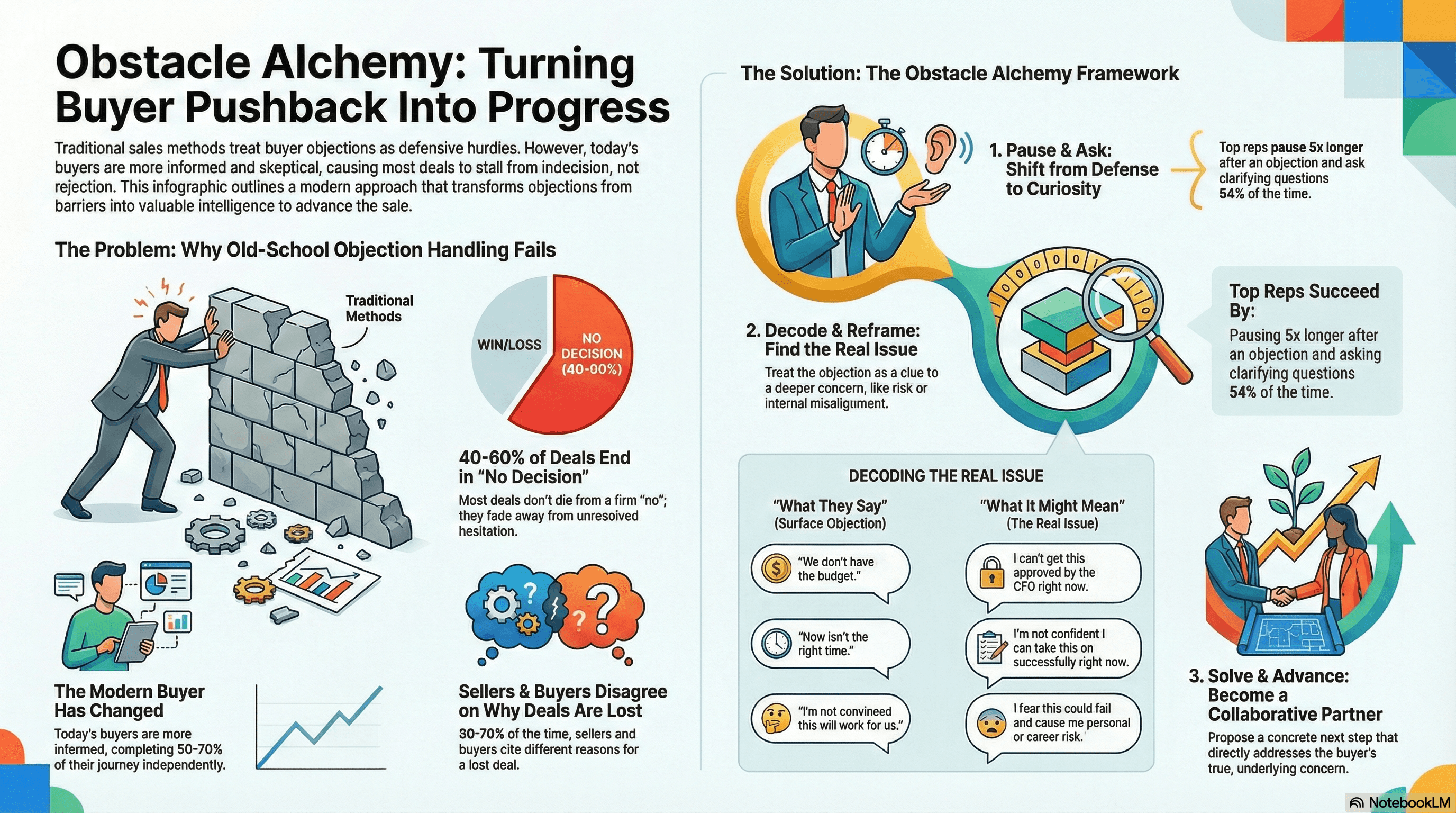
4. Reframe the Obstacle as a Joint Problem to Solve. Now that the true hurdle is clearly identified, reframe it from “the customer’s objection to my offering” into “our mutual problem to solve together.” This subtle shift in framing makes a big difference. Instead of adversaries (buyer says X is a problem, seller tries to argue X away), you become collaborators tackling X. For instance, if the clarified objection is “We’re worried about user adoption, because similar tools weren’t used by our team in the past,” don’t treat that as their skepticism to counter with generic stats. Instead, acknowledge it and bring yourself on the same side: “Got it – adoption is a valid concern. Let’s treat that as a design question we need to solve. Perhaps we can outline a pilot program with a subset of users to prove engagement, or schedule training sessions to ensure uptake. Let’s figure out what would give your team confidence.” Notice the language: “let’s treat that as a question we need to solve.” You’ve effectively turned the objection into a goal you share with the buyer (ensuring adoption), rather than a point of contention. This approach stems from the mindset that sales is something you do with the customer, not to the customer. By reframing the objection as a mutual challenge, you remove the stigma or defensiveness around it. Another example: if budget timeline is an issue, you might say, “It sounds like budget is tight this quarter – why don’t we strategize together? Maybe we can phase the rollout or demonstrate quick wins that unlock next quarter’s budget. Let’s find a way.” Suddenly, the buyer sees you as a problem-solver on their side, not a pushy vendor. This also helps maintain momentum: instead of the objection halting the discussion, it transforms into a planning session. The tone shifts from “convince me” to “collaborate with me.” From a psychological perspective, this step is about validating the buyer’s concern and then constructively redirecting it. You’re not dismissing their worry; you’re saying “Yes, that’s a challenge – and here’s how we (together) might overcome it.” Many complex sales are won by sellers who can navigate organizational obstacles for the buyer. By doing so, you add tremendous value beyond the product itself. In fact, research by Gartner found that customers who felt a supplier was helpful in solving their problems were significantly more likely to buy and had higher loyalty post-sale. This reframing sets you up to demonstrate that kind of helpfulness. [marketingscoop.com], [corporatevisions.com]
5. Prescribe a Next Step Based on the Buyer’s Internal Reality. The final step is to propose a clear path forward that directly addresses the specific concern uncovered. Think of this as the “treatment plan” after the diagnosis. It should be customized to the objection type and what you learned in step 3. Some examples:
If the issue is risk/credibility: “Would it help if we set up a pilot program for 30 days? That way, your team can see the results in your environment with minimal risk. We can define success criteria together. If it meets them, we proceed; if not, no obligation.” This shows you heard the “not convinced it’ll work here” and are willing to put skin in the game to prove it out.
If the issue is priority: “You mentioned other initiatives have the spotlight. Let’s quantify the cost of inaction on this problem. How about we work on a quick business case analysis that you can compare against other projects? If we find the status quo is costing more than you thought, that might raise the priority. Worst case, you have solid data for next budget cycle.” Here you’re tackling the “why now” collaboratively.
If the issue is resources/budget: “Given the budget constraints, we could phase the implementation. Phase 1 this quarter with a smaller investment and the remainder next fiscal year. Alternatively, is financing an option? We have programs that spread the cost. Let’s also involve your finance folks to see what structure could work.” This approach takes the pressure off a single fiscal period and engages with the economic buyer’s concerns.
If the issue is alignment: “It sounds like we need broader buy-in. I suggest we set up a workshop or demo with the key stakeholders, including the Ops and IT teams you mentioned, so everyone’s concerns are addressed. I’m also happy to provide internal champion materials – say a slide deck or ROI calculations – that you can use to brief your leadership. Let’s turn those skeptics into informed participants.” Here you’re stepping into an almost facilitative leadership role to unite the buying group (an approach “Challenger” sellers excel at).
If the issue is fit/credibility: “You’re not sure we’re the best fit – that’s fair. What if I arrange a reference call with a similar client of ours, or even better, a site visit so you can see the solution in action? Additionally, I can share a detailed proof-of-concept plan showing exactly how we would implement for your use case. That way you can judge based on evidence.” This directly tackles the trust gap by offering third-party validation and detailed proof.
The exact prescription will vary, but it must map to the specific concern uncovered. A generic next step (“I’ll send you more brochures”) won’t do. It should be something that meaningfully diminishes the buyer’s uncertainty or internally equips them. Notably, these next steps often go beyond the standard linear sales process – they are customized to address what’s actually blocking the deal. You may need to loop in different team members (a sales engineer for a technical workshop, your CFO for a call with their CFO, etc.). This is normal in complex sales.
Crucially, the goal at this stage is not persuasion; it’s enablement. You are no longer trying to convince the buyer that they shouldn’t worry – you’re helping them concretely resolve the worry. When you deliver on the agreed next step (be it a pilot, analysis, meeting, etc.), two things happen: (1) The objection loses power because it’s being handled, and (2) you demonstrate your reliability and partnership, which increases the buyer’s confidence in choosing you. It’s a win-win. You’ve effectively turned a point of resistance into an action item that moves the sale forward.
To see this framework in action, consider a scenario: A buyer says, “We love the product, but we just don’t have budget this quarter.” The average rep might either drop the price or say “okay, call me next quarter.” A high-performing rep will pause and reply: “Understood. Often when budgets are tight, it’s because other initiatives are taking precedence. Can you share what else the organization is focused on right now?” (Slow down & clarify). The buyer might reveal that a major internal reorganization and cost-cutting initiative is underway – lots of scrutiny on new spending, plus another department leader isn’t convinced about this project. Now the rep reframes and explores: “It sounds like the real challenge is making this a priority under current conditions and getting everyone comfortable. What if we treated the next few months as a pilot phase? We could start with a small team, using leftover budget from a different bucket, and measure results. In parallel, I can help you put together a report for the leadership to show how this ties into the company’s efficiency goals post-reorg.” The buyer agrees to try. The rep then executes that plan – which addresses both the budget timing issue (small pilot now, broader rollout later) and the internal alignment issue (equipping the buyer with a narrative and data to satisfy others). The deal, which previously would have died quietly, gets approved the next quarter once the pilot data demonstrates value and the internal stakeholders have been brought on board. The rep essentially engineered the opportunity from the initial objection. In doing so, they followed the Obstacle Alchemy steps: stay calm, diagnose the true blockers, partner with the buyer to solve those blockers, and chart a tailored course of action.


Implications for Leaders
For sales managers and leaders, this evolution in handling objections has several important ramifications:
Train for Interpretation, Not Evasion. Traditional objection handling training often focuses on rebuttal techniques – “If they say X, counter with Y.” That’s no longer sufficient. Reps need to be trained to interpret and explore objections, not just respond with a canned pitch. This means coaching skills like active listening, asking great follow-up questions, and being comfortable with silence. Role-playing should include practicing the pause after an objection and formulating exploratory questions. Instead of racing to flashcards of “objection answers,” training should reinforce a framework like the one above. By doing so, you build reps’ confidence in engaging with pushback rather than avoiding it. The goal is to turn every objection into a conversation about the customer’s needs. Notably, organizations that have pivoted their sales training in this direction see measurable results: in one study, companies that provided continuous, insight-driven sales training (versus one-time script training) enjoyed 16.6% higher win rates on average. Emphasize to your team that an objection is not a sign of failure – it’s progress. It means the buyer is actively considering issues. Celebrate objections as buying signals (because they are) and ensure your enablement materials help reps address each objection category with substance (e.g. have ROI calculators for cost objections, technical briefs for integration objections, etc.). [marketingscoop.com]
Make Objection Handling a Data-Driven Exercise. Just as we track win rates, leaders should track how well their team navigates objections. One powerful metric is win rate by objection type. If you find (via CRM notes or conversational intelligence software) that when “no budget” comes up your team wins only 5% of those deals, but wins 50% when “need more information” comes up, that’s incredibly useful insight. It highlights where the team’s skills or tools are lacking. Perhaps the team doesn’t know how to create urgency in low-priority situations – that’s a coaching opportunity. Modern conversational analytics tools (like Gong, Chorus) can even flag common objections and whether reps ask questions after them. Sales leaders should leverage these to identify patterns. For example, you might discover your top performers almost always ask at least one follow-up question when an objection arises, whereas low performers tend to either go silent or talk too much. That actionable insight can be coached across the team. Additionally, adjust your forecasting to account for unresolved objections. It’s not enough for a rep to say “this deal is at 80% confidence” if, say, the CIO raised a serious concern that’s still open. Encourage your team and sales ops to incorporate a “health of objections” criterion in deal scoring. One practical approach: during pipeline reviews, explicitly ask, “What objections have been raised? How are we addressing them? What’s the next step to resolve them?” Deals with significant unaddressed objections should be seen as high-risk in the forecast. In contrast, a deal where the objections have been tackled and next steps executed is far more likely to close. By focusing on objections in pipeline management, you’ll likely improve forecast accuracy (as you’re capturing the real hurdles) and also coach reps to never leave objections hanging without a plan. [scriptal.io]
Make Discovery a Continuous Process. Many salespeople do discovery only at the beginning of the sales cycle. But as we’ve seen, some of the most crucial insights (the “real” objections) emerge later on. Leaders should instill the mindset that discovery is not a one-and-done stage – it should continue throughout the deal. That means coaching reps to keep asking questions even in late-stage meetings: “Has anything changed since we last spoke? Are there any new concerns or stakeholders involved?” It also means leveraging multi-threaded discovery: use your champion to learn what others are thinking (e.g., “What has the CFO been asking about?”). The reality is that new objections can surface late in the journey as internal reviews happen – sellers must anticipate that. Managers can reinforce this by revisiting qualification periodically: “We assumed in the beginning that timing was right – is that still true? Are we sure we understand the approval process fully?” By treating discovery as an ongoing activity, you catch evolving issues early and show the customer you’re engaged till the end. This approach aligns with the concept of “buyer enablement” – continuously helping the buyer make the decision, not just pitching and then waiting. When sellers stay in discovery mode, they’re more likely to catch the unspoken objections too (the ones that buyers don’t voice but act upon, like going dark). This reduces unpleasant end-of-quarter surprises.
Revise Sales Methodology and Playbooks. If your sales methodology doesn’t account for internal buyer dynamics and decision psychology, it’s time to update it. Most resistance stems not from your product’s features but from the buyer’s environment and emotions. Incorporating teachings from methodologies like The Challenger Sale (which focuses on guiding buyers), SPIN selling (which focuses on uncovering Implications/Needs), or even Medic/MEDDICC (which emphasizes understanding the decision process and identifying champions) can elevate your team’s ability to handle objections. Ensure your playbooks include sections like “Common Customer Concerns and How to Navigate Them” – but importantly, not just pat answers, rather questions to ask and materials to provide. For instance, a playbook might say: If customer says “not sure about ROI,” here are 3 diagnostic questions to ask, a case study link, and an ROI calculator tool. This equips reps to execute the Obstacle Alchemy framework consistently. Additionally, integrate these principles into opportunity reviews: managers should ask reps not just “What’s the next step?” but “Why is that the next step – what concern or requirement is it addressing?” If a rep can articulate that, it shows they are connecting the dots between buyer pushback and sales actions.
Coach Emotional Intelligence and Regulating Response. There is an emotional dimension to objection handling. Reps who take objections personally or get anxious under pressure will struggle to execute the steps we’ve outlined. Sales leaders should coach and perhaps even formally train reps on emotional intelligence (EQ) skills: self-awareness, self-regulation, empathy, and social skills. This isn’t fluff – it directly affects performance. In a study of 1,000+ salespeople, those with high EQ were found to outperform low-EQ peers by 20% in revenue generated. Part of that is because emotionally intelligent reps manage stressful moments (like tough objections) more gracefully. Encourage reps to role-play high-stress scenarios in a safe setting so they build resilience. Teach them techniques such as taking notes when an objection is raised (it forces you to pause and shows the customer you care enough to write it down), or repeating back what they heard (“Let me make sure I’ve got this: your main concern is data security, is that right?”). These tactics buy time and demonstrate empathy. Also, share positive reinforcement: when a rep expertly navigates a hard objection, dissect that in team meetings as a best practice example. This creates a culture where objections are seen as challenges to be met skillfully, not attacks to fend off. Remember, buyers mirror tone – if a rep is calm and collaborative, buyers tend to respond in kind. If a rep is defensive or evasive, buyers get more skeptical or combative. One effective practice is to literally train reps to count “one one-thousand, two one-thousand” in their head after an objection before responding. It sounds trivial, but it’s a behavior change that was observed in top performers and can be coached. Over time, reps internalize that an objection is not an emergency – it’s an opportunity. As they see objections leading to better understanding and even wins (instead of something to fear), their confidence soars. And confident, curious salespeople are exactly what buyers want to deal with. [markselliott.com] [slideshare.net]
Actionable Takeaways for Sellers and Managers
Treat every objection as valuable data, not simply as resistance. Change your mindset from “They’re opposing me” to “They’re informing me.” An objection is the start of a deeper conversation, not the end of one. (Remember, studies show up to 60% of “no” outcomes are actually due to unaddressed indecision, not a firm rejection.) [hbr.org]
Always clarify the objection before responding. Don’t assume you understand exactly why the buyer said it. Ask follow-ups like, “Can you tell me more?” This not only buys you time but often uncovers the real issue (which may be different from the surface issue). Top reps do this 54% of the time after an objection, far more than average reps. [slideshare.net]
Classify the pushback by type and address the root cause. Is it about timing, money, risk, alignment, or fit? Each requires a different strategy. Align your response to what the buyer truly cares about. (For example, if it’s a risk objection, focus on ways to prove or guarantee outcomes; if it’s an alignment objection, focus on helping the buyer build consensus internally.)
Empathize and reframe the concern as a joint problem to solve. Use language that puts you on the buyer’s side of the table. e.g., “I understand why you’re concerned about X. Let’s figure out a way to address that together.” This lowers defenses and turns you into an ally. Sales research shows that sellers who collaborate and bring value are far more likely to win – 96% of buyers even say they’re influenced by sellers who focus on value and problem-solving. [customerthink.com], [customerthink.com]
Provide targeted next steps (solutions) that directly tackle the objection. Don’t leave the discussion without a game plan. Whether it’s a demo tailored to a skeptic stakeholder, a workshop on ROI, a trial period, or a reference call, have a concrete step. This not only advances the sale but gives the buyer confidence that their concern is being addressed professionally. (One sales team improved their overall win rate from 28% to 51% in part by implementing objection-specific playbooks and next steps.) [scriptal.io], [scriptal.io]
Record and learn from objections. After calls, analyze what objections came up and how you handled them. If you lost the deal, find out why – there’s a 50–70% chance the buyer’s true reason might surprise you. Feed these learnings into your future approach. Over time, you’ll start anticipating objections before they’re even voiced, and proactively addressing them (which is the pinnacle of sales enablement). [corporatevisions.com]
For managers: Foster a culture where reps aren’t afraid of objections but rather embrace them. Share success stories of “turning an objection into a deal.” During deal reviews, ask reps: “What objections have we encountered? How did we address them? Any still unresolved?” This keeps everyone focused on clearing obstacles, not just counting hopeful “yeses.” Also, consider updating KPIs – for instance, tracking how many deals with major objections still move to proposal stage, as a way to measure the team’s opportunity-engineering skill.
The modern approach to objections is not about having the slickest rebuttal. It’s about having the keenest understanding of the buyer. When you treat objections as a gift – an insight into what’s really going on – you differentiate yourself as a seller who “gets it.” You stop being a pushy salesperson and start being a valuable advisor. Ironically, by not “overcoming” objections in the traditional sense and instead working through them alongside the buyer, you overcome the true barriers to winning the deal. This is opportunity engineering: taking the raw material of buyer pushback and refining it into a path forward that wins business and builds trust.