Solution Focus
Modern Deals Don’t Fall Apart, They Stall Into Silence
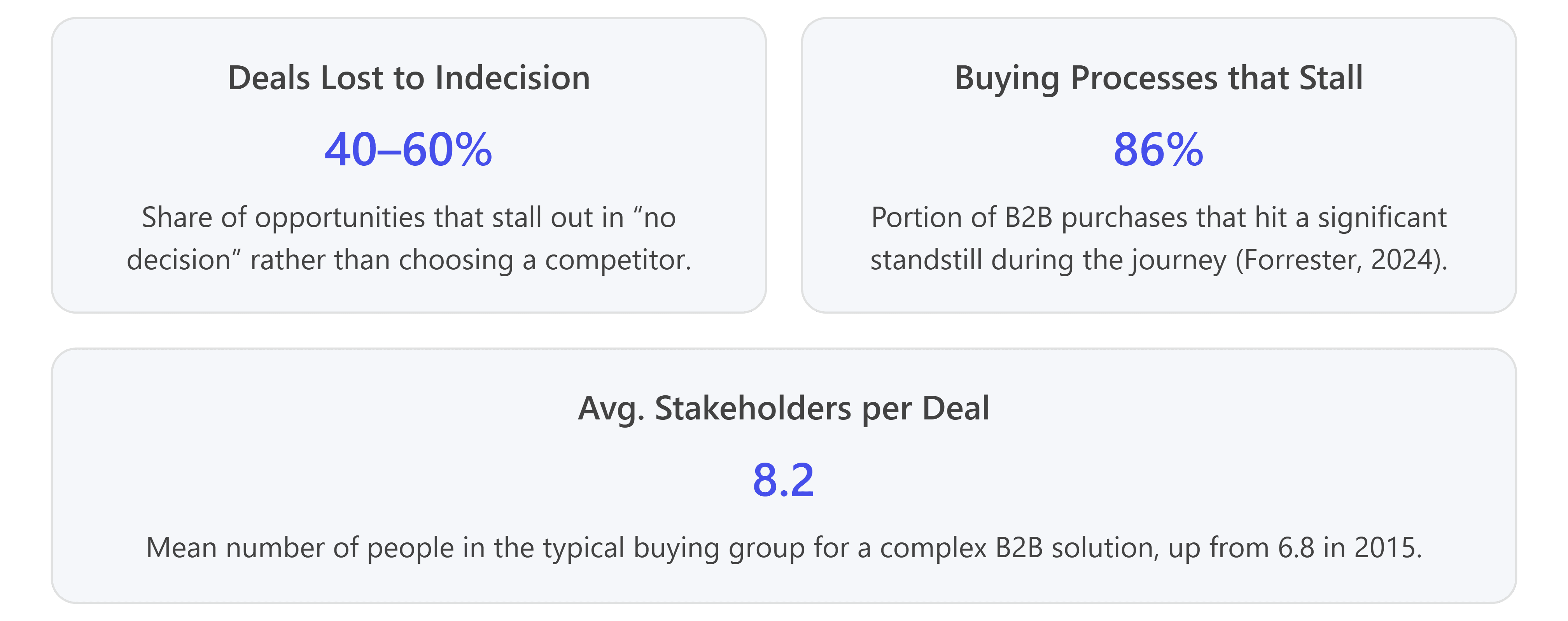
Modern B2B deals today rarely explode in a dramatic “no.” Instead, they fade into stall states – progress slows, communication goes quiet, and the deal slips into limbo. In fact, large-scale research shows anywhere from 40% to 60% of deals end up lost to “no decision” rather than to a competitor. These silent killers dominate pipelines: A 2024 Forrester study found 86% of B2B buyers experienced a stall in their buying process. As buying committees expand and risk aversion rises, forward momentum has become fragile. One LinkedIn/Edelman report revealed that over 40% of B2B deals stall due to internal misalignment in the buying group – so-called “hidden” stakeholders influencing decisions without a clear voice in discussions. In this environment, a stalled deal isn’t a sign of failure; it’s a system problem within the buyer’s organization. And like any system problem, it can be diagnosed and engineered toward a solution. [hbr.org] [corporatevisions.com] [marketing-...active.com]
Stalled Deals Are the Silent Killers of Pipeline Health
Ask any sales leader – the middle of the funnel is often where promising deals go to die. Reps may report that a proposal is “in procurement” or that the buyer will “get back to us after discussing internally,” but weeks pass with no movement. Data illustrates how pervasive this is: besides the high stall rate, Gartner finds that as stakeholder counts rise, decisions become exponentially harder – a deal with 5+ stakeholders has only a 31% chance of purchase, versus 81% with just 1–2 stakeholders. In other words, complexity breeds inertia. Common patterns behind stalled deals include: [marketingscoop.com]
Politeness perceived as progress. Buyers say things like “sounds good, we’ll review” which reps interpret optimistically, when in fact no real commitment exists. One study of sales conversations notes that indecisive customers often give positive verbal cues yet fail to act – a dangerous false signal. [6sense.com]
Unspoken buyer friction. Buyers often hesitate to share internal problems or political tensions. Economic uncertainty also makes them more cautious – psychological research shows that when stakes feel high, the brain’s threat response favors inaction to avoid potential failure. (Indeed, new research on buyer indecision found that of no-decision outcomes, 56% stem from the customer’s fear of making a wrong move – not merely satisfaction with the status quo.) [jolteffect.com]
Internal misalignment. Multiple stakeholders with divergent priorities can’t reach consensus, stalling the deal by default. It’s telling that “lack of internal alignment” is frequently cited as a top lost deal reason in CRM data, right alongside “no urgency”. Without a champion forging agreement, the buying group remains in limbo. [petavue.com]
Insufficient timeline pressure. With no compelling event or deadline, even a well-intentioned buying team can perpetually postpone a decision. (Reps often find that when Q4 or a contract end-date looms, stalled deals miraculously resurface – urgency forces action.)
Economic fears and risk sensitivity. Especially in uncertain times, companies default to safe choices or no choice. CFO oversight is now intense – 79% of purchases require CFO approval, and CFOs are quick to pause spending if value isn’t crystal clear. This creates a high bar for moving forward. [corporatevisions.com]
Misdiagnosed issues by the seller. Perhaps most frustrating, a rep might pour effort into the wrong remedy – pushing harder on price when the real issue is a hidden stakeholder’s concern, or sending more product info when the real blocker is lack of internal priority. Without identifying the true constraint, the deal remains stuck.
Bottom line: A stuck deal is not a “bad deal” or a personal failure. It’s usually a symptom that something in the buyer’s decision system has seized up. The task is to pinpoint that friction and proactively engineer a way around it. Momentum is the currency of modern selling – and the seller must become its architect.
A Solution Blueprint: Diagnose the Stall, Then Engineer the Advance
When a deal goes radio-silent or endlessly delayed, reactive tactics (another “checking in” email, offering a discount, etc.) rarely work. Instead, think like a systems engineer. The following blueprint lays out a structured approach to restart a stalled deal:
Part I: Diagnose the Stall State
Before jumping into action, identify what type of stall you’re facing. Through our analysis, most stalled deals fall into one of five categories:
1. Priority Stall: “This isn’t urgent enough.”
Symptoms: Sporadic or slow responses; feedback like “we’ll revisit next quarter”; lack of any firm timeline or project deadline. The deal just isn’t top of the buyer’s agenda.
Root Cause: Competing initiatives outrank your solution. The status quo isn’t painful enough, or other projects have stolen focus. In essence, the problem you solve isn’t currently a priority. (It’s telling that “lack of urgency or timeline” is a top-cited reason for lost deals in many B2B teams’ data.) [petavue.com]
2. Risk Stall: “This feels risky.”
Symptoms: Excessive questions about implementation details; hesitancy around “what if it doesn’t work;” requests to defer until more certainty (e.g. a pilot or reference). You might hear concerns like “if this fails, it will reflect poorly on us.”
Root Cause: Buyer fear and uncertainty. They may personally fear making a bad decision (especially if the purchase is high-profile). Neuroscientists note that ambiguity or risk triggers the limbic “freeze” response in our brains, leading to decision paralysis. Recent sales research (the JOLT Effect) found that more than half of no-decision losses are driven by customer indecision and fear of failure – rather than a contentment with the status quo. In a risk stall, the buyer hasn’t been made to feel safe enough to move forward. [jolteffect.com]
3. Alignment Stall: “We’re not aligned internally.”
Symptoms: New stakeholders emerge late in the process (each with their own concerns); you receive conflicting feedback from different team members; or there are frequent internal meetings “to get everyone on the same page” with no resolution. The buying group may keep “circling back internally” without ever coming out with a unified stance.
Root Cause: Lack of internal consensus. The more stakeholders involved, the more likely someone’s concerns are halting progress. This is exceedingly common now – Gartner’s data shows the typical buying group has 8+ members, and the chance of a purchase drops to 31% when 5 or more people are involved. It only takes one or two dissenters to create a stalemate. (No wonder a LinkedIn/Edelman report found internal misalignment to be behind 40%+ of stalled deals.) Until the key stakeholders reach a shared vision, the deal will remain stuck. [marketingscoop.com] [marketing-...active.com]
4. Resource Stall: “We don’t have the budget or bandwidth.”
Symptoms: Soft objections about cost (“budget is tight right now”), or delays tied to finance approvals. Perhaps the project is put on hold pending next quarter’s budget, or the buyer cites limited team bandwidth to implement your solution.
Root Cause: Financial or operational constraints. This can mean a genuine budget freeze (especially in economic downturns) or simply that your proposal hasn’t cleared the economic gatekeepers. It could also reflect bandwidth concerns – the team feels they can’t handle the project now. Notably, 79% of B2B purchases now require CFO sign-off, so any deal without a clear ROI and low-effort plan will face resource pushback. In a resource stall, the buyer may want the solution but genuinely doesn’t see a feasible way to pay for it or implement it at the moment. [corporatevisions.com]
5. Credibility Stall: “We’re not fully convinced – or we have other options.”
Symptoms: Vague, hard-to-pin-down hesitation (“we’re still thinking it over”); repeated comparisons to a competitor or the status quo; lack of enthusiasm in stakeholder meetings. The buyer isn’t asking many questions anymore – a sign they may not believe your solution is the answer.
Root Cause: Insufficient differentiation or trust. The buyers might not yet see the unique value or ROI of your solution for them. Alternatively, they may question your company’s capabilities or support. If key doubts are unresolved, the safest course for the buying group is to stall. Consider that even when purchases do happen, 81% of buyers report being dissatisfied with the chosen vendor in hindsight – often because the solution didn’t meet expectations or the provider overpromised. In a credibility stall, that kind of doubt is happening before the purchase. The vendor has not fully established credibility or addressed all concerns, so the buying committee hesitates to green-light the deal. [corporatevisions.com]
Identifying the stall type is 70% of the battle. Treating the wrong problem will only deepen the stall. For example, if the core issue is risk (fear of failure) but you mistake it for a price concern, you might offer a discount – doing nothing to assuage the buyer’s real anxieties. Diagnose first, then act.


Part II: Re-Establish the Signal – Create a Reason to Re-Engage
Once you know the likely stall cause, the next step is to re-engage the buyer with a jolt of new value. Buyers rarely restart a stagnant process because a sales rep “checks in.” They re-engage when something changes in the equation: new clarity, reduced risk, simplified next steps, or a fresh insight that recaptures their attention. In other words, you need to reset the narrative.
Ask yourself: Why should the buyer reply to me now? If all you’re offering is “Can I get an update?”, you’re likely to be ignored. Instead, offer something that directly speaks to the stall state:
For a Priority Stall: Surface a consequence or opportunity that makes the problem more urgent. For instance, share a brief cost-of-inaction analysis that quantifies what waiting is costing them each month. Or tie your solution to a strategic initiative the company cares about (e.g., “I know improving CX is a 2024 goal; this project could accelerate that by quarter’s end.”). The idea is to move your solution from nice-to-have to need-to-have now. Reps who connect their offering to buyers’ immediate objectives see far better re-engagement – one LinkedIn study noted that thought leadership aligning with a buyer’s current priorities made 95% of hidden stakeholders more receptive to sales outreach. [sendtrumpet.com] [marketing-...active.com]
For a Risk Stall: Provide a safety net. This could be proposing a pilot program or trial period, offering a mutual “exit ramp” (e.g. opt-out clauses) or sharing a detailed implementation plan addressing their “what if it goes wrong” worries. The goal is to show you are actively de-risking the decision. For example: “We could start with a 60-day pilot in one department – zero cost until we prove the value. Let’s map success criteria together.” Concrete assurances like these change the buyer’s calculus by lowering the perceived downside. Supporting evidence from similar customers can help too (e.g., case studies focusing on smooth roll-outs). In essence, you’re saying, “We will help you succeed without making you stick your neck out.”
For an Alignment Stall: Step into the role of consensus builder. Offer to facilitate an internal workshop or roundtable with all key stakeholders. Often a neutral, structured discussion led by the vendor can flush out concerns and get everyone on the same page. You might reach out with: “I suspect there are differing viewpoints internally. I’ve helped other clients in your situation host a short alignment session – would that be useful to get everyone’s concerns on the table?” Additionally, provide tools for your internal champion: an internal FAQ, a one-page summary of the value proposition for each department’s angle, etc. The re-engagement signal here is “I will help your team reach agreement.” After all, big buying groups are notoriously hard to coordinate – any help you offer in orchestrating consensus is extremely valuable (Gartner notes that proactive guidance to navigate stakeholder dynamics is a hallmark of high-performing sellers). [marketingscoop.com], [marketingscoop.com]
For a Resource Stall: Acknowledge the constraint and propose a workaround. For example, suggest a phased implementation or payment plan: “What if we break the project into Phase 1 (this quarter) and Phase 2 (next fiscal year)? That cuts the upfront cost by 50%, and we can still start delivering results now.” If headcount bandwidth is the problem, perhaps offer extra training or a light deployment mode that requires minimal effort from their team. The key is to show you’re flexible and can engineer the deal to fit their constraints. Many vendors during tight-budget periods introduce creative commercial options (like consumption-based pricing or short-term licenses) to keep deals moving. If budget approval is the hurdle, come armed with an ROI business case to help your champion justify the spend – or even re-scope the solution to a smaller pilot (overlap with risk stall solution). By re-engaging with a solution to the resource issue, you change the buyer’s mindset from “we can’t do this” to “maybe there is a way.”
For a Credibility Stall: Bring new proof or perspective. If the buyer isn’t convinced, simply repeating your pitch or asking what they think will not break the stalemate. You need to introduce something that shifts their perception. Options include: scheduling a call with a reference customer in the same industry (letting your happy client convince them for you), providing a tailored case study or ROI report relevant to their use case, or offering a deeper demo/workshop focused on their specific requirements to show your solution’s competence. Another approach is to frankly address any outstanding doubts – for example, if they’re worried about a particular feature gap or a competitor, provide a comparison or roadmap info that shows you’ve got it covered. Fundamentally, a credibility stall ends when the buyer trusts your solution and your company to deliver. Building that trust might require bringing in a technical expert or consultant to validate your claims. It’s worth noting that buyers today heavily rely on independent information – only 9% of buyers consider vendor websites a trustworthy information source – so the more you can leverage third-party validation and real-world evidence, the faster you’ll rebuild credibility. [corporatevisions.com]
In all cases, your re-engagement outreach should deliver a new insight, plan, or value – not just ask the buyer to do something. The moment they see “Oh, this addresses exactly what we were hung up on,” you’ll earn their attention again. Think of it as sending up a signal flare that cuts through the fog of their indecision.
Part III: Resolve the True Constraint with a Targeted Solution
Re-engaging the customer is necessary, but not sufficient. Once you’ve got them back to the table (even if only for a brief discussion or email exchange), focus on resolving the core issue head-on with a tailored strategy. Each stall type has a corresponding play to engineer progress:
If Priority was the problem (low urgency): Re-link the project to strategic priorities and create time pressure. You must help the buyer see that doing nothing has a cost. Quantify the pain of the status quo in terms that matter to them – e.g. “each month without a solution is costing you $X in lost productivity/revenue”. Tie your solution to active corporate initiatives: “This addresses the Q3 customer retention goal you mentioned.” In some cases, introducing a deadline or trigger can help – for example, a limited-time incentive or a milestone that the solution needs to be in place by (such as an upcoming product launch or peak season). Be careful: artificial deadlines or generic discounts don’t create true urgency and savvy buyers will see through them. Instead, genuinely align the deal with things the organization already cares about. The result you want is the buyer internally saying, “We can’t afford to wait on this.” (Pro tip: If possible, elevate the conversation to an executive level, where broader strategic impact is seen. Senior sponsors can cascade urgency down to the committee. Data shows executive involvement can reignite stalled deals by reframing the solution as business-critical rather than optional.) [sendtrumpet.com]
**If Risk avoidance was the problem: De-risk the path forward in concrete ways. This is where you implement a “Land and Expand” or pilot approach if feasible. Offer a smaller initial deployment, a trial, or a conditional opt-out. The psychological effect is profound – it switches the buyer’s internal question from “What if this goes wrong?” to “We can test if this will go right.” According to sales research, giving customers a safety net greatly reduces their loss aversion and increases deal closure rates. You should also double down on building confidence: share implementation plans, assign a dedicated customer success resource to guide them, and co-create a success roadmap. For example, create a mutual “Success Plan” that outlines each step from purchase to achieved outcomes, with your team’s support at every step. When buyers tangibly see that the risks are mitigated and manageable, their emotional blockers subside. As Matt Dixon’s indecision research highlights, buyers worry more about messing up (FOMU) than missing out – so show them they won’t mess up. By offering, say, “Try this with one team for 8 weeks, and if it doesn’t deliver the results, you can walk away at no cost,” you are effectively taking the fear off the table. [jolteffect.com]
**If Internal Alignment was the problem: Engineer consensus and clarity. Here, the salesperson’s role shifts from persuader to facilitator. One effective tactic is to host an “alignment workshop” or executive briefing where all stakeholders attend and you guide them through areas of agreement and concern. Come with an agenda that surfaces each team’s requirements and gets commitment on a unified set of criteria or next steps. Another useful tool is to arm your champion(s): provide internal slide decks or talking points tailored to each stakeholder’s interest (e.g. a one-pager for Finance highlighting ROI, a tech explainer for IT addressing integration). Encourage your champion to set an internal deadline for decision, and help them enforce it by offering, for example, to present findings to an executive sponsor by that date. Essentially, you are volunteering to do some of the herding of cats that the buying group struggles with. Research by Gartner suggests that sellers who proactively manage the purchase process (e.g., by mapping stakeholders and facilitating consensus-building meetings) significantly improve deal progression in complex sales. In practice, this could mean introducing tools like a mutual decision plan that outlines who needs to approve what and by when. Transparency can flush out hidden hold-ups. Your mantra: “Let’s all get on the same page.” Once the group achieves clarity on the problem, solution, and value, momentum can resume. [marketingscoop.com], [marketingscoop.com]
**If Resources (budget/bandwidth) were the problem: Re-design the deal for feasibility. Work with the buyer to creatively reduce the investment required – without reducing the value. Can you offer a smaller package or a shorter-term contract to fit their budget cycle? (For example, many SaaS providers will break an annual contract into a quarterly starter agreement if budget is a near-term issue.) Can you adjust payment terms – such as ramping up payments later, or tying fees to achievement of milestones? If internal bandwidth is constrained, can your team or a partner absorb some implementation tasks (e.g., a turnkey deployment that doesn’t strain their staff)? By showing flexibility, you demonstrate partnership, not just selling. A classic move here is a phased rollout: “Let’s start with Department A this quarter (small scope, small cost) and plan for Departments B and C next year once we’ve proven ROI.” This reduces the immediate resource ask and splits the decision into bite-sized pieces. The key is to get some form of yes now, even if it’s a smaller yes, rather than an indefinite maybe. Negotiating scope or terms in this way can revive a deal that was stalled by a budget freeze. Keep in mind, financial approvers respond to hard ROI – so arm your champion to defend the spend. Provide updated business case figures focusing on cost savings, efficiency gains, or revenue impact that justify proceeding even under constraints. When a solution is seen as self-funding or low risk financially, CFOs are far more likely to approve it (especially if you’ve also mitigated risk as above). In short, make the deal easy to say yes to given the buyer’s resource reality.
**If Credibility (or solution fit) was the problem: Deliver more proof and insight until confidence is achieved. Often, this stall requires elevating the conversation from vendor vs vendor to problem vs solution approach. You might need to help the buyer reframe how they’re thinking about the problem so they see your approach as uniquely valuable. For instance, share industry insights or benchmarking data: “Organizations that address X in this way see a 20% faster growth...” – positioning your solution approach as the modern best practice. Meanwhile, directly tackle any lingering doubts: bring in a product expert or executive to personally assure the buyer on those points. Show a detailed roadmap if a missing feature is causing pause. If a competitor is clouding the picture, carefully differentiate (focus on how your strengths align better to the buyer’s stated needs). At this stage, providing hands-on experience can tip the scales: offer an extended trial, or invite them to a reference customer site visit. Seeing is believing. The idea is to convert any abstract uncertainty into concrete understanding. Also, rebuild trust by demonstrating expertise: perhaps perform a mini audit or workshop on the buyer’s challenge (without pitching) – essentially giving free consulting. This proves you know your stuff and are committed to their success, not just the sale. Since buyer trust in vendors is generally low today (the majority of buyers seek independent information over sales collateral), leaning on third-party endorsements and transparent actions is key. Ultimately, a credibility stall breaks when the buyer feels “This vendor really understands our problem and can deliver the value we need – I’m convinced.” At that point, whatever vague objections were holding them back tend to evaporate. [corporatevisions.com]
After implementing the targeted solution, confirm with the buyer that their concern is addressed: “Does this approach make you feel comfortable to proceed?” Look for genuine agreement. If you’ve done it right, the answer will be yes, or at least “yes, if we can also do [minor thing].” Now you’re getting somewhere.
Part IV: Establish Forward Momentum Through Structured Next Steps
Restarting a deal isn’t a single event – it’s a process of rebuilding momentum. Once you’ve resolved the immediate issue, engineer the deal’s progression with a clear, structured plan. Don’t assume the buyer will automatically drive things on their side even after they’re re-engaged. As the seller, you need to proactively facilitate the remaining journey:
Set a clear timeline with the customer. Establish a mutually agreed sequence of steps and dates (also known as a mutual action plan or close plan). For example: “This week we’ll have the security review; next week, you’ll brief the VP and we’ll join for Q&A; by March 15th we’ll aim to finalize commercial terms.” Writing this down and getting the buyer’s buy-in is critical. It turns nebulous intent into concrete commitments. Research backs this up – deals that include a formal mutual action plan can see significantly higher win rates. One analysis found that opportunities with a buyer-seller co-created action plan had nearly 2× higher close rates (around 60% vs 29% baseline). The act of agreeing on next steps creates accountability and keeps everyone on track. [sendtrumpet.com]
Build in internal checkpoints for the buying group. Help the buyer team maintain momentum internally by scheduling check-ins or progress reviews. For instance, suggest a short recap meeting after a pilot phase, or a presentation to department heads at a certain milestone. This prevents drift and signals that progress is expected. It also gives you visibility into whether the deal is advancing behind the scenes. Key is to make these steps collaborative – e.g., “How about we all regroup on X date to evaluate pilot results and adjust the plan?” By structuring these moments, you replace open-ended delays with scheduled decision points.
Maintain shared ownership and keep tasks mutual. In a stalled deal recovery, you might be tempted to take on all the work to make things happen. But don’t let the buyer go passive – they need to carry certain commitments, too (like gathering stakeholder feedback, completing a required assessment, etc.). Make sure the action plan clearly delineates who does what. A truly mutual plan might say, “Buyer will secure initial sign-off from Legal by Aug 1, Seller will deliver updated SOW by Aug 3.” When both sides invest effort, the deal has momentum. Interestingly, data shows that how engaged the buyer is can predict deal success – one study of mutual action plans found win rates soared above 80-90% when the buyer completed 6 or more agreed-upon action items in the plan. The takeaway: momentum comes from joint progress, not just seller-driven tasks. [sendtrumpet.com]
Monitor and communicate progress (micro-wins). Each time a step is completed – celebrate it. Send a brief “recap of what we accomplished this week” to all stakeholders. This reinforces the sense of forward motion. Behavioral science tells us that visible progress boosts motivation and reduces perceived risk of continuing. Even a small win, like “we got user sign-off on requirements,” builds confidence for the next step. Keep the tone positive and future-focused: “Great, with X behind us, we’re now in a strong position to finalize Y.” By narrating progress, you make the momentum tangible. Conversely, if a scheduled step slips, address it openly and reset the timeline – don’t let delays compound silently. [sendtrumpet.com]
Establish a target decision date. Without a target close date, even re-energized deals can meander. Based on the re-engagement talks, propose a reasonable but firm decision deadline: “If we implement these steps, do you think we could reach a decision by September 1?” Aim for a commitment. This creates a gentle time discipline on the process. It’s not about rushing (never pressure the buyer arbitrarily), but about aligning on a goalpost. If the buyer agrees to a date, psychologically they’re more inclined to push toward it. In pipeline reviews, deals with a mutual close date tend to get more focus from both seller and buyer – it’s a shared finish line.
The purpose of all this structure is to prevent the deal from slipping back into stall status. You’re effectively engineering momentum: each step completed is momentum gained, each scheduled next step is momentum protected. By the end, the decision to approve the deal should feel like the natural culmination of a series of logical, low-friction steps – not a leap into the unknown.
To illustrate how this blueprint comes together, consider a real-world example:
A mid-market SaaS deal had stalled after several product demos. The prospect went silent for weeks. The sales rep dug in and diagnosed an Alignment Stall – new stakeholders had appeared and there were conflicting agendas (some wanted an analytics tool, others worried about integration effort). Instead of bombarding the main contact with follow-ups, the rep changed approach. He suggested an “executive alignment workshop” with all stakeholders. In that session, he walked through each team’s goals and concerns (using an interactive Miro board) and facilitated a discussion until the group reached consensus on two core requirements and a phased approach. Post-workshop, he sent a one-page summary of the agreed plan, which all stakeholders signed off on. This renewed internal clarity unlocked the deal – within days, the buying group set up a meeting with their CFO to seek budget approval for the phased rollout. The deal closed the next month. Notably, the solution wasn’t a sales gimmick or a price cut; it was better internal engineering. By solving the alignment problem and giving the group a clear plan, the rep reignited momentum.
Implications for Sales Leaders:
For managers and sales enablement leaders, guiding your team to handle stalled deals with this engineered approach can have a huge impact on win rates and forecast accuracy. A few considerations:
Treat stall symptoms as diagnostic signals, not excuses. When a rep says “they’ve gone dark” or “the deal is stuck in legal,” dig deeper. Why is it stuck? Is it truly a legal review issue, or is legal an excuse because someone internally isn’t sold? Train your team to identify the stall category. Use deal reviews to classify each stuck opportunity by stall type instead of simply labeling it “unresponsive.” This shifts the mindset from blame to problem-solving. It also improves forecasting – a deal stalled due to budget (resource stall) has a different recovery probability than one stalled due to indecision (risk stall). By distinguishing them, you can more realistically assess pipeline health. [corporatevisions.com]
Coach “advance engineering,” not just persistence. It’s not enough to tell reps “try again” or “push harder.” Encourage them to leverage the tactics above: rebuild value, reorganize the buying process, bring new ideas to the table. Role-play stalled deal scenarios in coaching sessions. For example, have the rep practice re-engaging a hesitant buyer by introducing an ROI calculator or proposing a pilot. Emphasize that pushing the customer (pressure, repeated follow-ups) can backfire – Dixon’s research noted that traditional tactics like hammering on the status quo actually backfire 84% of the time with indecisive customers. Instead, coach reps to alleviate the customer’s sticking point (fear, confusion, etc.). Over time, a team skilled in diagnosing and fixing stalls will markedly improve conversion of later-stage opportunities. Even a modest improvement can be huge – if currently 50% of mid-funnel deals are stalling out, cutting that to 30% could yield a significant boost in bookings. [jolteffect.com]
Enable with content and tools. Equip your sellers with resources tailored to each stall scenario. For instance: cost-of-delay calculators and case studies for priority stalls, ROI templates and pilot frameworks for resource/risk stalls, stakeholder mapping templates and workshop guides for alignment stalls, competitive briefs and customer testimonials for credibility stalls. Make these easily accessible. Also consider standardizing the mutual action plan template for your team – as noted, having a shared close plan can double win rates. If your CRM allows, implement fields to document identified stall reasons and actions taken; this can help managers spot patterns (e.g., if “stakeholder misalignment” stalls are prevalent, maybe your marketing should produce more multi-stakeholder collateral). The point is to operationalize the solution blueprint into your sales process. [sendtrumpet.com]
Normalize stalls as part of complex sales – but insist on a plan to address them. Reps shouldn’t feel stigma or panic when a deal stalls; it happens to everyone. What you want to avoid is paralysis or giving up. By embracing a problem-solving culture, your team stays proactive. Celebrate examples where a rep “rescued” a stuck deal by creative tactics – it reinforces the right behavior. Conversely, discourage complacency around stalled deals (“they’ll come back next quarter on their own”). Pipeline review meetings should include not just what is stuck, but why and how we’ll fix it. When leadership consistently frames stalls as temporary states that can be engineered back to motion, reps adopt that mindset too.
In essence, managing stalled deals should become a repeatable discipline within your sales org. It’s part of revenue operations, not just individual rep heroics. Measure it – for instance, track the percentage of stalled deals that are re-activated and closed each quarter, and share those metrics. If Q2’s stalled deals were mostly revived in Q3, identify what made the difference and reinforce those practices.
Actionable Takeaways:
Diagnose before acting. When a deal gets stuck, first classify the stall (priority, risk, alignment, resource, or credibility). The solution will be very different for each. Use evidence – listen to what the buyer has (or hasn’t) said – to pinpoint the root cause.
Re-engage with new value, not “checking in.” Give the buyer a concrete reason to come back to the table. Provide a fresh insight, a revised plan, or an offer that directly addresses their hesitation. A stalled buyer needs a brain jolt of value or clarity to regain interest.
Target the true constraint with a tailored fix. Once re-engaged, focus your proposal on solving the specific issue that caused the stall. Whether it’s a phased rollout for a budget issue or a pilot for a risk-averse customer, make sure your plan neutralizes the blocker. One size does not fit all.
Engineer momentum through structure. Don’t let the deal drift after restarting. Build a simple, mutual action plan with the customer that outlines next steps and deadlines. Share responsibility for tasks and keep the process moving in a controlled way. Remember, deals with structured next steps are far more likely to close (e.g. mutual close plans have ~60% win rates vs 30% without). [sendtrumpet.com]
Treat deals as systems, not linear transactions. When a deal stalls, it’s usually telling you something about the buyer’s internal system. Approach it like a consultant: diagnose the system constraint, redesign the workflow, and get the system running again. This mindset shift – from “convincing the customer” to “helping the customer’s system make a decision” – is the key to unlocking stuck opportunities.
By following this solution blueprint, sellers can transform the frequent frustration of stalled deals into an opportunity to differentiate themselves. You’re no longer just a vendor; you become a problem-solver and guide. In today’s complex B2B environment, that’s exactly what buyers need to push a decision across the finish line. By diagnosing stall patterns and engineering momentum, you’ll not only revive deals that would otherwise die silently – you’ll also build deeper trust with your customers (and likely see more wins as a result). The modern sales professional isn’t just a persuader; they’re an engineer of decisions. And when you can reliably get stuck deals unstuck, you become an invaluable partner to your buyers and a hero to your own bottom line.